Pink Princess Philodendron — At a Glance
| Detail | Info |
| Botanical Name | Philodendron erubescens ‘Pink Princess’ |
| Common Names | Pink Princess, PPP, Pink Princess Philo |
| Family | Araceae (Aroids) |
| Light | Bright indirect light |
| Watering | When top 1 inch of soil is dry |
| Humidity | 50-70% |
| Temperature | 18-29 C (65-85 F) |
| Soil | Chunky, well-draining aroid mix |
| Fertilizer | Balanced liquid, monthly (spring-summer) |
| Mature Size | 60 cm to 1.2 m indoors |
| Toxicity | Toxic to cats and dogs |
| Difficulty | Easy to Moderate |
What Is the Pink Princess Philodendron?
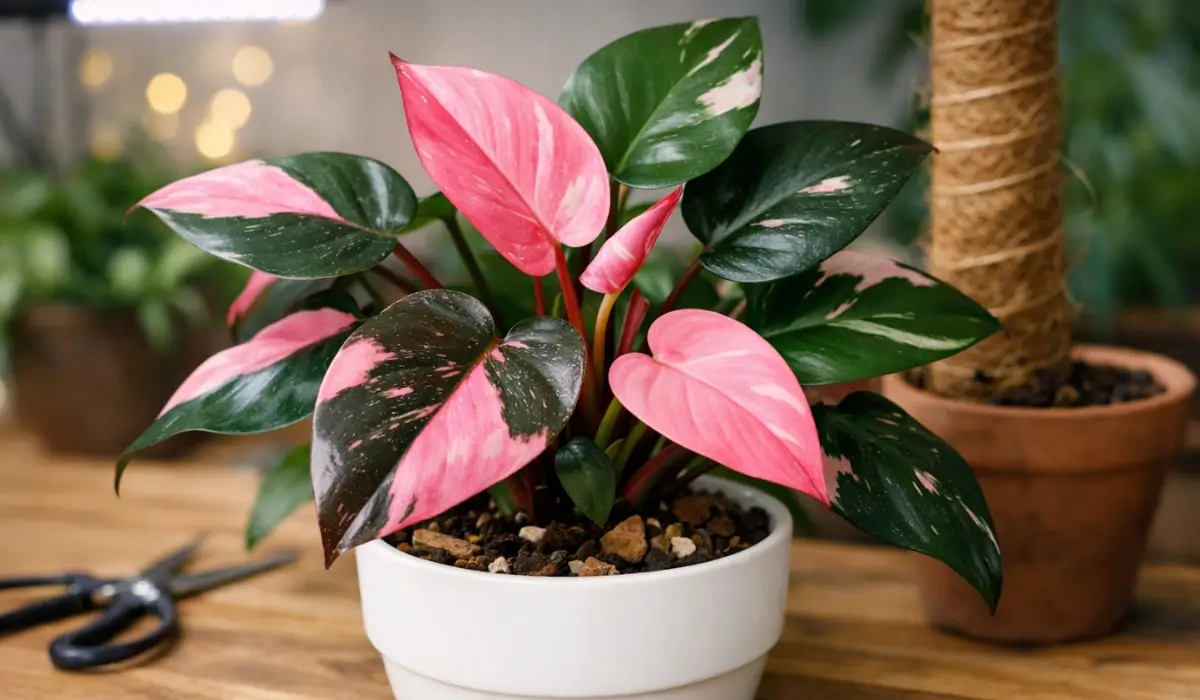
The Pink Princess Philodendron (Philodendron erubescens ‘Pink Princess’) is one of the most sought-after houseplants in the world. Its deep green, waxy leaves are dramatically splashed with patches of bright bubblegum pink — a natural genetic mutation that prevents chlorophyll from forming in certain leaf cells, creating that iconic two-toned look.
Unlike the pink princess pothos (which is an entirely different plant — Epipremnum aureum), the true pink philodendron plant is a climbing aroid native to the tropical rainforests of South America. It has been selectively cultivated over many years to enhance variegation, which is why a well-variegated specimen still commands premium prices.
Whether you have a tiny juvenile pink princess philodendron, a fresh pink princess seedling, or a full grown pink princess philodendron — this guide covers every stage of the journey.
If you are just getting started with tropical houseplants, our Bamboo Palm care guide is a perfect companion read — bamboo palms thrive in the same warm, humid conditions your Pink Princess loves.
How to Care for Pink Princess Philodendron
The question we hear most often is: are pink princess philodendrons easy to take care of? The honest answer is yes — more forgiving than their exotic appearance suggests. Once you nail two things — bright light and proper drainage — the philodendron pink princess is a genuinely low-maintenance houseplant.
The only real challenge in philodendron pink princess care is maintaining that gorgeous pink variegation, which requires consistently bright indirect light. Get the light right and everything else falls into place.
| Care Factor | Requirement | Pro Tip |
| Light | Bright indirect | East or west window ideal |
| Watering | Top 1 inch dry between waterings | Terracotta pot helps prevent overwatering |
| Soil | Chunky aroid mix | Add perlite and orchid bark |
| Temperature | 18-29 C (65-85 F) | Away from AC vents and cold windows |
| Humidity | 50-70% | Mist or use pebble tray |
| Fertilizer | Monthly spring-summer | Half-strength balanced liquid feed |
| Repotting | Every 1-2 years | Go up only one pot size at a time |
Pink Princess Philodendron Light Requirements
Light is the single most critical factor in pink princess philodendron care. The pink patches on leaves are produced by cells that lack chlorophyll — meaning they cannot absorb light. When overall light levels drop, the plant compensates by producing more green (chlorophyll-rich) cells. The result: your prized pink princess philodendron slowly reverts to plain green.
Your pink princess light requirements in simple terms: bright indirect light for 8-10 hours daily. A spot 60-90 cm from a south or east-facing window works beautifully. Avoid direct afternoon sun, which bleaches and scorches leaves.
| Should you use a grow light for Pink Princess Philodendron? Yes — here is what to buy A quality grow light for pink princess philodendron is one of the best investments you can make. LED grow lights placed 30-50 cm above the plant for 10-12 hours a day maintain and enhance pink variegation during winter or in low-light homes. Look for full-spectrum LED grow lights rated at 2,000-4,000 lux. |
Pink princess light requirements checklist:
- Best: 60-90 cm from a bright east or south-facing window
- Acceptable: North-facing window with a grow light supplement
- Avoid: Direct midday sun — causes leaf bleaching and burn
- Warning: All-green new leaves = needs more light immediately
Best Soil for Pink Princess Philodendron
Getting the pink princess philodendron soil right prevents 90% of problems new owners face. In their natural habitat, these plants grow in loose, fast-draining, organic-rich forest floors. Recreate those conditions at home and your plant will thrive.
The ideal DIY aroid soil mix:
- 40% peat-free potting mix — moisture-retaining base that supports root growth
- 30% perlite or coarse pumice — ensures fast drainage, prevents waterlogging
- 20% orchid bark (chunky) — adds essential air pockets, mimics forest floor conditions
- 10% worm castings — slow-release nutrients that gently feed roots without burning
If you prefer ready-made, look for any branded aroid potting mix. Just avoid standard all-purpose potting soil alone — it retains too much moisture and will slowly suffocate the roots of your princess philodendron plant.
How Often to Water Pink Princess Philodendron
There is no single number for how often to water pink princess philodendron — it depends on your pot size, soil mix, humidity, and season. The one rule that never fails: water when the top 1 inch of soil feels dry to the touch.
In practical terms:
- Spring and summer (active growth): every 7-10 days
- Autumn and winter (slower growth): every 14-21 days
| Overwatering Warning The #1 killer of Pink Princess Philodendron Yellow leaves, mushy stems near the base, and a persistently wet or musty-smelling pot all signal overwatering. Check the roots immediately. Trim any brown mushy roots, let the plant dry out for a day, then repot in fresh aroid mix. Act fast — root rot spreads quickly. |
Always water thoroughly — let water drain through the drainage holes — then let the soil partially dry before the next watering. Never let your pink princess philodendron plant sit in a saucer of standing water. Terracotta pots are excellent for growers who tend to overwater.
Fertilizer for Pink Princess Philodendron
The best fertilizer for pink princess philodendron is a balanced, water-soluble liquid fertilizer — a 20-20-20 NPK or a dedicated aroid fertilizer. Apply at half strength once a month during spring and summer.
Stop fertilizing from late October through February. In winter the plant grows slowly and cannot absorb nutrients properly — excess fertilizer accumulates as salt deposits that damage roots over time.
| Tip: Boost Pink Variegation with Smart Feeding Feed strategy for more pink on new leaves Try a slightly higher-nitrogen fertilizer in early spring when new leaves are just pushing out, then switch to balanced feed through summer. Combined with good light, this noticeably improves the pink-to-green ratio on new growth. |
How to Propagate Pink Princess Philodendron
Wondering how to propagate pink princess philodendron? Great news — it roots readily and reliably. The method is stem cutting propagation. The philodendron pink princess propagation process works because this plant naturally produces roots from its nodes — the small ridges on the stem just below each leaf.
According to plant experts at Gardeners’ World, Pink Princess cuttings propagate most successfully when taken in spring or early summer during active growth — giving roots the best conditions to establish quickly.
Step-by-Step: How to Propagate Pink Princess Philodendron
- Choose the right stem. Select a healthy stem with at least one pink princess philodendron node (the small brown ridge below a leaf joint). A pink princess philodendron cutting with 2-3 nodes gives the best success rate.
- Make a clean cut. Use sterilized scissors or pruning shears. Cut 1-2 cm below the lowest node. Sterilize your tools with rubbing alcohol first to prevent disease spreading.
- Callous the cut end. Leave the cutting pink princess philodendron in a dry spot for 30-60 minutes. This brief drying period helps prevent rot once placed in water or substrate.
- Root in water or perlite. Submerge the node end in room-temperature water (change every 3-4 days) or press into moist sphagnum moss or perlite. Both methods work excellently.
- Provide warmth and indirect light. Place in a warm spot (22-25 C) with bright indirect light. A clear propagation box over the cutting boosts humidity and speeds rooting significantly.
- Pot up when roots reach 3-5 cm. Once your pink princess propagation has established roots, move to a small pot with aroid mix. Keep soil moist for the first two weeks.
| Can you propagate from just a node? (Wet Stick Method) Yes — here is how it works A bare pink princess philodendron node — called a ‘wet stick’ — can root and eventually push out new growth even without an attached leaf. It takes 4-8 weeks longer than a leafed cutting, but it works well. This is how most rare variegated cuttings are sold by specialist collectors online. |
Understanding soil nutrients is crucial when potting up propagated cuttings. Read our guide to 5 essential soil nutrients for indoor and balcony plants to make sure your rooted pink princess cutting gets the best possible start.
Growth: How Big, Climbing, Trailing & Hanging
How big do pink princess philodendrons get indoors? A typical mature pink princess philodendron reaches 60 cm to 1.2 metres tall as a houseplant, with individual leaves spanning 10-20 cm each. In consistently warm, humid conditions with regular feeding, some specimens push significantly beyond this.
Do pink princess philodendrons climb? Absolutely. In nature they use aerial roots to climb trees, producing progressively larger leaves as they ascend. Giving your pink princess philodendron plant a moss pole or wooden stake encourages this natural climbing habit — resulting in bigger leaves and the most dramatic variegation.
Prefer a trailing pink princess philodendron? Without support, stems cascade beautifully from a shelf or hanging planter. A hanging pink princess philodendron in a macrame hanger near a bright window is one of the most stunning ways to display this plant.
| Pink Princess Philodendron Small Leaves? Here is how to fix it Small leaves are almost always caused by insufficient light, a root-bound pot, or under-fertilizing. Move the plant closer to a light source first — this solves the issue in most cases. If light is already good, check whether roots are circling the pot base and repot if needed. A pink princess philodendron large specimen comes from consistent feeding and good light. |
Common Problems & Philodendron Diseases
- Yellow leaves: Almost always overwatering or poor drainage. Let soil dry more between waterings. Check drainage holes are not blocked.
- Brown leaf tips: Low humidity or inconsistent watering. Mist leaves, add a pebble tray, or use a small humidifier.
- Root rot: Mushy brown roots with a bad smell. Trim affected roots, allow to dry for a day, repot in fresh aroid mix.
- Bacterial leaf spot (philodendron disease): Dark water-soaked spots with yellow halos. Remove affected leaves, improve air circulation, avoid wetting foliage.
- Mealybugs: White cottony patches in leaf joints. Treat with a cotton swab dipped in diluted isopropyl alcohol or neem oil.
- Spider mites: Fine webbing under leaves, usually in dry conditions. Raise humidity and treat with neem oil spray.
- Green reversion (no pink on new leaves): Not a disease — a light response. Move to a brighter spot or add a grow light immediately.
Dealing with other issues across your indoor plant collection? Our detailed guide to 7 common houseplant problems and their solutions covers root rot, pests, yellowing, and drooping across a wide range of popular houseplants.
Is Pink Princess Philodendron Toxic to Cats?
This is one of the most important questions for pet owners — pink princess philodendron cats: is it safe? The answer is no. All philodendrons contain calcium oxalate crystals, which are toxic to cats and dogs if ingested. Chewing on leaves or stems causes:
- Oral irritation and excessive drooling
- Vomiting and difficulty swallowing
- Swelling of the mouth and throat in more serious cases
| Pet Safety — Keep Away From Animals What to do if your cat chews the plant Place your pink princess plant in a hanging planter well out of reach, on a very high shelf, or in a room your pets cannot access. A hanging pink princess philodendron is a practical and beautiful pet-safe solution. If your cat or dog ingests any part of the plant, contact your vet immediately. |
Frequently Asked Questions About Pink Princess Philodendron
Are Pink Princess Philodendrons easy to take care of?
Yes — they are more forgiving than their exotic look suggests. Once you establish the right light and watering routine, this plant practically takes care of itself. The main challenge is maintaining pink variegation, which requires consistently bright indirect light. Beginners who get the light right find this plant very rewarding.
How do you propagate a Pink Princess Philodendron?
Take a healthy stem cutting with at least one node, let the cut end callous for 30-60 minutes, then root it in water or moist perlite. Keep in a warm spot (22-25 C) with bright indirect light. Roots typically appear within 2-4 weeks. Once roots are 3-5 cm long, pot the cutting up in aroid mix.
How big do Pink Princess Philodendrons get?
Indoors, a mature Pink Princess Philodendron typically reaches 60 cm to 1.2 metres tall. With a moss pole and ideal conditions — warmth, humidity, and regular feeding — some specimens grow even larger. Leaves on climbing plants can reach 15-20 cm in length.
Why is my Pink Princess losing its pink variegation?
This is almost always a light issue. When light levels drop, the plant produces more green cells to compensate. Move it closer to a bright window or add a full-spectrum grow light for 10-12 hours daily. New leaves should show improved pink variegation within a few growth cycles.
Is Pink Princess Philodendron toxic to cats?
Yes. Like all philodendrons, the Pink Princess contains calcium oxalate crystals which are toxic to cats, dogs, and other pets if ingested. Symptoms include oral irritation, drooling, vomiting, and difficulty swallowing. Keep the plant out of reach and contact a vet immediately if your pet chews any part of the plant.
Do Pink Princess Philodendrons climb or trail?
Both. The Pink Princess is a natural climber that will grow up a moss pole or trellis, producing larger leaves as it ascends. Without support, stems trail beautifully from a shelf or hanging basket. Both forms are equally attractive indoors.
What is the difference between Pink Princess Philodendron and Pink Princess Pothos?
They are completely different plants. Pink Princess Philodendron (Philodendron erubescens) has deep green leaves with bold pink-and-green variegation and distinctive reddish stems. Pink Princess Pothos (Epipremnum aureum) has lighter green foliage with whitish or pale yellow variegation. The Philodendron is rarer, more expensive, and has a more dramatic colour contrast.
Does the Pink Princess Philodendron flower?
It can, but flowering indoors is very rare. The pink princess flower is a typical aroid bloom: a spathe and spadix structure similar to a peace lily. Most indoor growers never see it flower. The dramatic pink and green foliage is the real attraction.
What soil is best for Pink Princess Philodendron?
A chunky, well-draining aroid mix is best. Combine 40% peat-free potting mix, 30% perlite, 20% orchid bark, and 10% worm castings. This replicates the loose, fast-draining forest floor the plant naturally thrives in. Avoid standard all-purpose potting soil alone.
How do I make my Pink Princess more pink?
Maximize bright indirect light (or add a quality grow light), fertilize monthly with balanced liquid feed during spring and summer, maintain warmth above 18 C and humidity above 50%, and give the plant a moss pole to encourage climbing. Larger leaves on climbing plants show the most dramatic pink variegation.
Final Thoughts
The Pink Princess Philodendron is one of those rare plants that genuinely delivers on its reputation. Those bold pink patches, the waxy deep green leaves, the way each new leaf unfurls with its own unique variegation pattern — it never gets old.
And the best part? Once you understand what the philodendron pink princess actually needs — bright indirect light, well-draining pink princess philodendron soil, careful watering, and warmth — it is not a difficult plant to keep. The pink princess philodendron plant will reward consistent care with gorgeous new growth, season after season.
Whether you are trying to propagate pink princess philodendron from a philodendron pink princess cutting, choosing the right grow light for pink princess philodendron, or simply learning the daily pink princess philodendron care routine — you now have everything you need to grow this plant confidently.
Now go give your plant some love.