
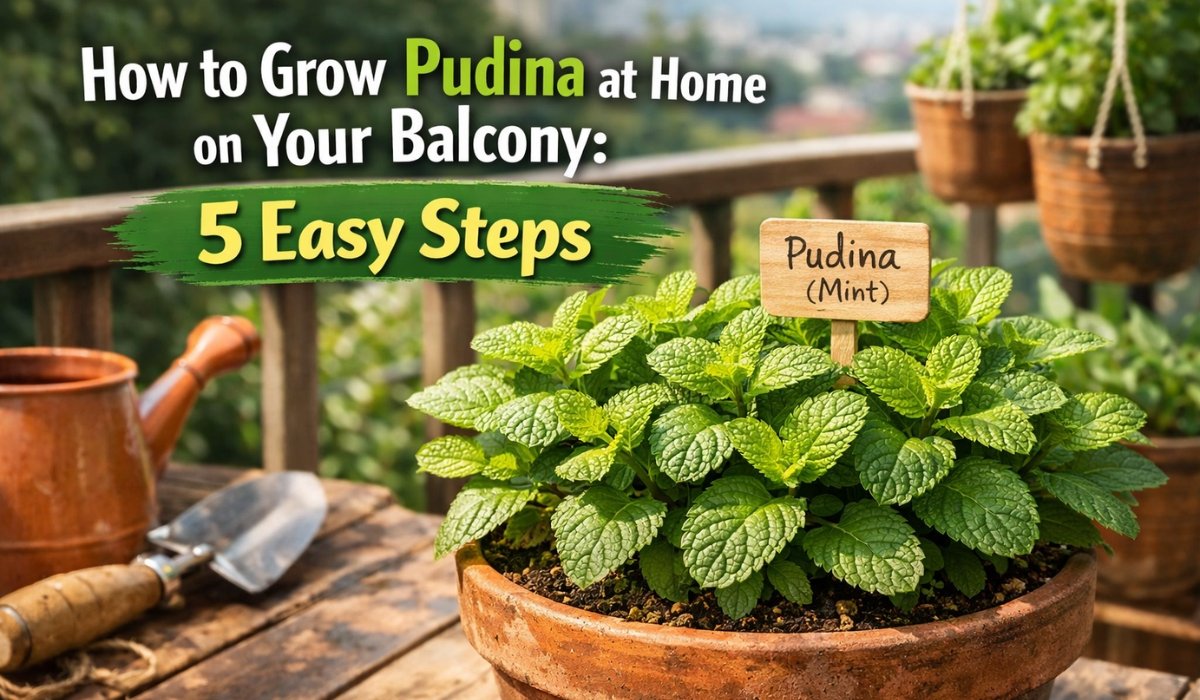
Fresh pudina from your own balcony is sharper, more fragrant, and far more satisfying than the wilted bunch from the sabziwala. And unlike most plants, mint actually thrives in pots — it doesn’t need a garden, doesn’t need much space, and grows fast enough that you’ll have a working harvest in three to four weeks.
If you’re just getting started with a balcony herb garden, pudina is the right first plant. It’s forgiving, hard to kill, and useful enough that you’ll use it constantly once it’s growing.
Step by Step How to grow pudina at home
Step 1: Start with Stem Cuttings, Not Seeds
Seeds are slow, inconsistent, and give you no real advantage here. The faster route: buy a fresh pudina bunch from your vegetable market and propagate directly from those stems.
Pick stems that are 10–15 cm long and look healthy — no yellow leaves, no bruising. Strip the leaves from the bottom half of each stem, then drop them in a glass of water. Leave them on your kitchen counter near a window. In 5–7 days, you’ll see small white roots forming at the nodes. Once roots reach about 1 cm, they’re ready to plant.
This method has a very high success rate. The few cuttings that don’t root are no real loss — just replace them from the next bunch.
External resource: Royal Horticultural Society — Growing Mint covers propagation in more detail if you want to go deeper on mint varieties.
Step 2: Choose the Right Container
Pudina roots spread outward, not downward. A wide, shallow container works far better than a deep one — something around 30 cm across and 15–20 cm deep is ideal. You don’t need an expensive pot. A recycled plastic tub, an old paint bucket, or any container you have at home works perfectly, as long as it has at least one drainage hole.
No drainage hole is the single biggest mistake balcony gardeners make with mint. Waterlogged soil causes root rot within a week — the plant won’t survive it. If you’re unsure which container type suits your balcony best, this container material guide explains the differences between plastic, terracotta, and fabric pots.
Step 3: Use the Right Soil Mix for Pudina Plant Care
Standard potting soil compacts over time and holds more water than mint likes. A better mix: two parts potting soil, one part cocopeat, one part perlite or coarse river sand.
Cocopeat retains just enough moisture without getting soggy. Perlite opens up the texture so roots can breathe. Both are available at nurseries or online for under ₹200 total. Getting this soil mix right is one of the most overlooked aspects of pudina plant care — and it makes a visible difference in growth speed and leaf quality.
Fill the pot to about 3 cm from the rim, plant your rooted cuttings roughly 5 cm apart, and water gently until it drains from the bottom. Understanding your soil’s nutrient profile also helps — this guide on essential soil nutrients for balcony plants is worth a read once your plant is established.
Step 4: Find the Right Spot — Morning Sun, Afternoon Shade
Pudina wants 4–6 hours of sunlight, but harsh afternoon sun — especially through Indian summers — scorches the leaves and strips out the aroma. A spot that gets morning light and moves into shade by early afternoon is close to perfect. East-facing balconies are naturally good for this.
If your balcony only gets strong western sun, move the pot back from the railing or use a basic shade net. Pale leaves with dry, crispy edges are the first sign the plant is getting too much direct heat.
This placement logic applies to most balcony herbs. If you’re growing oregano or thyme alongside your pudina, the same light rules apply — check out this guide on growing oregano and thyme in pots for a full comparison.
Step 5: Water Consistently and Harvest from the Tips
Check moisture before every watering: press your finger 2 cm into the soil. Dry? Water thoroughly until it drains from the bottom hole. Still moist? Leave it another day. In summer, this usually means daily watering. In cooler months, every two to three days is enough.
Once the plant reaches 15–20 cm and looks bushy, start harvesting — always from the tips, never pulling full stems, and never more than one-third of the plant at a time. This isn’t just caution: cutting from the tips actively signals the plant to branch and grow denser. The more consistently you harvest, the more productive the plant becomes.
After two to three months, you’ll likely see roots emerging from the drainage hole. At that point, either repot into a larger container or divide it into two pots. Most balcony growers end up with two or three pudina pots without planning to.
Common Pudina Problems and How to Fix Them
Yellowing leaves: Almost always overwatering. Let the soil dry out between waterings and check the drainage hole isn’t blocked.
Plant going to flower: Pinch off flower buds the moment you see them. Once pudina flowers, leaf production slows and the flavour weakens considerably.
Leggy, sparse growth: Not enough light, or the plant needs a harder trim. Cut it back by half and move it to a brighter spot.
Plant looks dead in summer: Cut it back hard to 5 cm above the soil. It will almost always bounce back with fresh growth within two weeks — mint is remarkably resilient.
Roots coming out of the drainage hole: Time to repot or divide. Don’t ignore this — a root-bound plant stops producing well.
If you’re dealing with broader plant health issues beyond just mint, this houseplant problems guide covers the most common ones with practical fixes.
Frequently Asked Questions
How long does pudina take to grow from cuttings?
Roots form in 5–7 days in water. After potting, the plant is ready to harvest in 3–4 weeks.
Can I grow pudina indoors without a balcony?
Yes, but it grows slower and with less fragrance. A bright windowsill with 4+ hours of indirect light works. A balcony with morning sun is noticeably better.
How often should I water pudina in a pot?
Daily in summer, every 2–3 days in cooler months. Always check the soil first — consistent overwatering kills mint faster than underwatering.
Does pudina need fertiliser?
Not immediately. After 6–8 weeks, a diluted liquid fertiliser once a month keeps growth healthy. Avoid heavy doses — mint doesn’t need much feeding to thrive.
Can I grow pudina with other herbs?
Yes. Pudina grows well alongside tulsi, oregano, and thyme. Keep it in its own pot though — it spreads aggressively and will crowd out neighbouring plants in a shared container. If you also want to grow tulsi, this tulsi plant care guide is a good companion read.
Pudina is one of those plants that, once you’re growing it, you won’t go back to buying it. Give it a decent pot, morning light, and consistent harvesting — it’ll do the rest.
And if pudina is your starting point for a bigger balcony garden, the beginner’s gardening blueprint is a solid next step.







