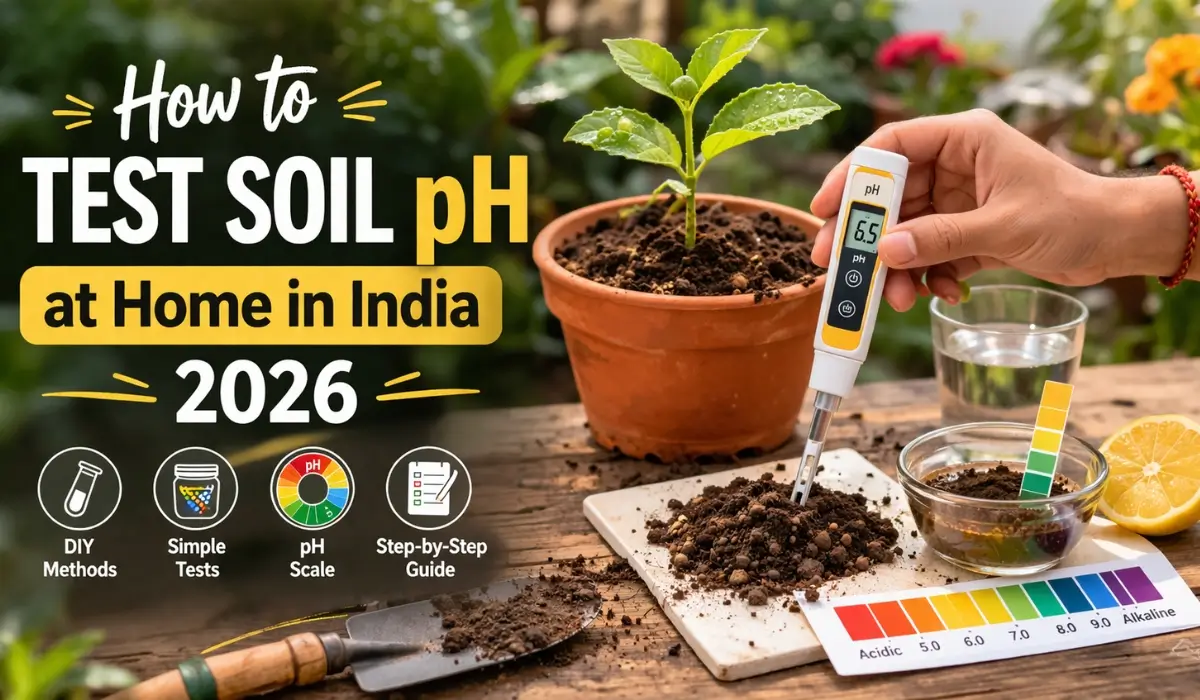
Knowing how to test soil pH at home is one of the most useful things an Indian gardener can do — and almost nobody does it. If your tomatoes are flowering but not fruiting, your spinach is yellowing despite regular watering, or your roses refuse to bloom no matter how much fertiliser you add, the answer is often not nutrients or water. It is pH. A soil that is too acidic or too alkaline locks out nutrients that are physically present in the mix, making feeding useless until the pH is corrected. This guide shows you exactly how to test your soil pH at home in India using tools that cost under ₹300 — and what to do once you have the result.
Quick facts
| Difficulty | Easy — no prior experience needed |
| Time required | 10–15 minutes per test |
| Tools needed | pH strips or testing kit · distilled or RO water · small glass · spoon |
| Cost | ₹150–₹300 for a 100-strip pH kit |
| Best time to test | Before planting — October (Rabi season) and June (Kharif season) |
| Ideal pH for most vegetables | 6.0–7.0 (slightly acidic to neutral) |
What is soil pH and why does it matter for Indian gardens
pH is a measure of how acidic or alkaline your soil is, on a scale of 0 to 14. A pH of 7.0 is neutral. Below 7.0 is acidic, above 7.0 is alkaline. Most vegetables, herbs, and flowering plants grown in Indian home gardens prefer a slightly acidic to neutral range of 6.0 to 7.0 — a window where nutrients are most available and soil microbes are most active.
Outside that range, problems multiply quickly. In acidic soil below 5.5, aluminium and manganese become toxic to roots. In alkaline soil above 7.5 — common in North Indian gardens and in soils irrigated with hard tap water over many years — iron, manganese, and zinc become chemically unavailable even when present in the soil. Plants show deficiency symptoms despite being fed regularly because the nutrients simply cannot be absorbed at that pH.
According to the Indian Council of Agricultural Research (ICAR), soil reaction (pH) is one of the most critical soil properties affecting nutrient availability and crop productivity in Indian agricultural systems — and this applies equally to container and kitchen gardens.
The good news: testing takes under 15 minutes, and correcting pH — once you know what you are dealing with — takes one ingredient and a few weeks.
pH levels, what they mean, and which plants prefer them
Use this table as a reference when you get your test result. Most common Indian garden plants fall into the 6.0–7.0 column — but knowing the exceptions saves you from feeding a plant into deficiency.
| pH range | Soil type | Plants that prefer this range | Common problem signs | Fix |
|---|---|---|---|---|
| Below 5.5 | Strongly acidic | Blueberries (4.5–5.5), azaleas | Aluminium toxicity, stunted roots, yellowing in most vegetables | Add garden lime: 150–200 g per pot |
| 5.5–6.0 | Mildly acidic | Potatoes, sweet potatoes | Mild nutrient lockout in heavy feeders | Add lime: 50–100 g per pot |
| 6.0–7.0 | Slightly acidic to neutral — ideal | Tomatoes, chillies, brinjal, leafy greens, most herbs, marigold, rose | None — this is the target range | No amendment needed |
| 7.0–7.5 | Mildly alkaline | Okra, asparagus, brassicas (cabbage, cauliflower) | Iron deficiency in acid-loving plants — yellowing between leaf veins | Add sulphur: 25–50 g per pot |
| Above 7.5 | Strongly alkaline | Very few food crops — most struggle | Iron, zinc, manganese deficiency across most plants; poor germination | Add sulphur: 75–100 g per pot + increase vermicompost |
Indian city note: Garden soils in Delhi, Lucknow, and Jaipur tend toward alkaline (7.5–8.5) due to calcium-rich geology and hard irrigation water. Soils in Mumbai, Pune, and most of coastal Karnataka and Kerala tend toward neutral to mildly acidic (6.0–7.0) and rarely need amendment. Test before assuming.
How to test soil pH at home — step by step
The most reliable home method uses pH testing strips or a liquid soil pH kit, both available for under ₹300 online or at agricultural supply shops. Here is the full process:
- Collect your soil sample correctly. Scoop 2–3 tablespoons of soil from 5–8 cm below the surface — not from the very top, which is affected by surface debris and does not represent root-zone conditions. If testing a pot, sample from the middle depth. If testing a garden bed, take samples from three or four spots and mix them together for an average reading. Air-dry the sample for 20–30 minutes if it is very wet.
- Use distilled or RO-filtered water — not tap water. Tap water in many Indian cities is alkaline (pH 7.5–8.5 in Delhi; 7.0–7.8 in Mumbai) due to treatment chemicals and mineral content. Using tap water will give you a falsely high pH reading. Distilled water or water from a home RO filter is reliable and accurate.
- Mix soil and water in a 1:1 ratio.Place your soil sample in a clean glass. Add an equal volume of distilled water. Stir well with a spoon and let it sit for 2 minutes so the soil fully disperses into the water.
- Dip your pH strip or apply the kit solution. For pH strips: dip one strip into the mixture for 10–15 seconds, remove, hold flat, and compare the color immediately against the chart on the packet. For liquid kits: add 2–3 drops of indicator solution to the soil-water mix, swirl gently, and compare the resulting colour against the kit’s reference chart.
- Read and record your result. Note the number. Test 3–4 different pots or spots in your garden separately and record each reading — pH can vary significantly between pots, especially if you have used different soil mixes or fertilizers.
- Amend if needed and retest in 3–4 weeks. For acidic soil below 6.0: mix garden lime (calcium carbonate) into the top layer of soil at 100–150 grams per medium pot (30 cm diameter). For alkaline soil above 7.5: add agricultural Sulphur powder at 50–75 grams per pot, or increase vermicompost significantly. Retest after 3–4 weeks before planting to confirm the shift.
I tested the soil in my terrace garden pots in Bangalore in August 2024 after noticing that my curry leaf plant had been showing yellowing between the veins for two months despite weekly feeding. The pH strip read 7.8 — mildly alkaline, which was locking out the iron the plant needed. I mixed 60 grams of sulphur powder into the top soil layer of the pot and watered it in. Four weeks later the new growth came out a healthy dark green, and I have not had the problem since.
The turmeric test — a free home method
If you do not have a pH kit and need a rough answer quickly, the turmeric test is a traditional Indian method that works as a basic indicator.
Mix a teaspoon of your soil sample with just enough water to make a thick paste. Place it on a white plate or saucer. Sprinkle a small pinch of turmeric powder over the paste and observe the colour change over the next 2–3 minutes.
If the paste turns bright red or pink, your soil is alkaline — turmeric’s curcumin compound reacts with alkaline conditions to produce this colour shift. If there is no colour change, the soil is neutral or acidic.
The turmeric test cannot tell you how acidic or how alkaline — it gives you a binary answer, not a number. Use it as a first check, then follow up with a pH strip for a precise reading before making any soil amendments. It is, however, completely free and accurate enough to tell you whether you have an alkalinity problem before spending money on lime or sulphur.
Testing soil pH during Indian growing seasons
The best time to test is before planting, so you have time to amend and retest before your seedlings go in. Align your testing with India’s main growing seasons:
Before Kharif season (May–June): Test in April or early May before the monsoon arrives and before you sow warm-weather crops like okra, chillies, brinjal, and cucumbers. Monsoon rain is naturally slightly acidic and can gradually lower pH in open garden beds — check each year rather than assuming last year’s reading still holds.
Before Rabi season (October–November): Test in September or early October before sowing cool-weather crops like tomatoes, leafy greens, peas, and carrots. This is the most important testing window for North Indian gardeners, where soil alkalinity tends to be highest after a summer of alkaline tap water irrigation.
Zaid / summer crops (February–March): If growing summer vegetables like bottle gourd, bitter gourd, or melons, test in February. Summer heat accelerates organic matter breakdown and can shift pH slightly — particularly in containers where soil volumes are small and changes happen faster.
For container gardeners, test each pot individually rather than assuming they are the same. Different soil mixes, different watering histories, and different fertilisers mean two pots sitting side by side can have meaningfully different pH values.
How to fix acidic soil in Indian home gardens
If your test result is below 6.0, your soil needs to become less acidic. The standard amendment is garden lime — calcium carbonate — which is inexpensive and available at agricultural supply shops and nurseries across India.
For container plants, add 100–150 grams of garden lime per medium-sized pot (30 cm diameter) by mixing it thoroughly into the top 5–8 cm of soil. Water well after application. For garden beds, apply at roughly 150–200 grams per square metre. Lime works slowly — allow 3–4 weeks and retest before planting.
Wood ash is an alternative that many Indian home gardeners already have available — it is alkaline and raises pH gently. Apply at 50–100 grams per pot and mix into the top soil layer. It also adds potassium, which benefits flowering and fruiting plants. Do not use coal ash, which can introduce contaminants.
Vermicompost and well-rotted cow dung compost also have a mild buffering effect, gently nudging acidic soil toward neutral over time. Increasing your organic matter content is always worth doing regardless of which amendment you choose.
How to fix alkaline soil in Indian home gardens
Alkaline soil above 7.5 is the more common problem in North Indian home gardens and in containers that have been watered with hard tap water for years. The standard fix is agricultural sulphur, which soil bacteria convert to sulphuric acid over several weeks, gradually lowering pH.
Apply sulphur powder at 50–75 grams per medium pot for mild alkalinity (7.5–8.0), or 75–100 grams per pot for strongly alkaline soil above 8.0. Mix into the top 5–8 cm of soil, water well, and wait 3–4 weeks before retesting. Sulphur works more slowly than lime — be patient and do not over-apply.
Peat moss is a faster-acting acidifier used in nursery settings, but it is expensive and less eco-friendly than sulphur for Indian home gardeners. A more practical approach for container gardeners is switching to a cocopeat-heavy potting mix, which is naturally slightly acidic, and using RO or rainwater for irrigation instead of hard tap water. Over one to two growing seasons, this alone can bring mildly alkaline container soil into the ideal range.
For an in-depth guide on building the right base, see our article on the best soil mix for container plants in India, which covers the cocopeat-perlite-vermicompost ratios that keep container pH naturally stable.
Common soil pH testing mistakes to avoid
Using tap water for the test. As noted above, tap water in most Indian cities is alkaline and will push your reading higher than the actual soil pH. Always use distilled water or RO-filtered water. This is the single most common source of incorrect home pH test results in India.
Testing the very top of the soil. The surface layer is affected by fertiliser salts, mulch decomposition, and surface runoff. Roots live 5–15 cm down — sample from that depth for a reading that reflects what your plants actually experience.
Testing only once. pH varies across a garden and between pots. Test multiple locations and record each result separately. Treating the whole garden based on one reading from one corner can lead to over-amendment in areas that did not need it.
Amending and planting immediately. Lime and sulphur need 3–4 weeks to change soil pH. Planting immediately after amendment means your seedlings go into soil that has not yet reached the target pH. Test, amend, wait, retest, then plant.
Forgetting to retest after amendment. Over-liming or over-applying sulphur can push pH too far in the other direction. Always retest 3–4 weeks after amendment before adding more. A second overshoot is harder to correct than the original problem. Learn how to pick the right gardening tools — including a reliable pH tester — before you start amending.
Frequently asked questions
How do I test soil pH at home without a kit?
You can test soil pH at home without a kit using turmeric powder. Mix a teaspoon of soil with water to form a paste, then add a pinch of turmeric. If the paste turns red or pink, the soil is alkaline. No colour change indicates acidic or neutral soil. This is a rough indicator, not a precise reading — use a pH strip for accuracy.
What is the ideal soil pH for vegetables in India?
Most vegetables grown in India — including tomatoes, chillies, brinjal, and leafy greens — grow best in slightly acidic to neutral soil with a pH of 6.0 to 7.0. Blueberries are an exception and prefer more acidic soil around 4.5–5.5. Checking pH before planting saves significant time and fertiliser cost.
Is Indian tap water safe to use for soil pH testing?
No — tap water in many Indian cities, including Delhi and Mumbai, is treated with alkaline chemicals and has a pH of 7.5–8.5. Using it for soil pH testing will give a falsely high reading. Always use distilled water or filtered RO water when mixing your soil sample for testing.
How often should I test soil pH in my garden?
Test soil pH at least once a year, ideally before the main planting season — October for Rabi crops and June for Kharif crops. If you have recently added lime, sulphur, or heavy compost, retest after 3–4 weeks to confirm the pH has shifted to the desired range before planting.
Where can I buy a soil pH testing kit in India?
Soil pH testing kits and litmus strips are available at most agricultural supply shops, nurseries in metro cities, and online from Ugaoo, TrustBasket, and Amazon India. A basic 100-strip pH testing kit costs approximately ₹150–₹300 and is accurate enough for home garden use.
Test once, grow better all year
Testing soil pH at home takes under 15 minutes and costs less than ₹300 for a full year of testing. It is one of the highest-return things you can do for your garden — because it tells you why problems are happening, not just that they are. One test before Rabi season and one before Kharif season is enough to keep most Indian home gardens in the ideal range year-round.
If you have never tested your soil before, start this weekend. Pick up a pH strip kit from a local nursery or order online, collect samples from three or four pots, and write down what you find. Even if the reading is perfect, you will have a baseline — and that baseline is what makes every subsequent growing season easier to manage.
Tried the turmeric test or got an unexpected result from your pots? Share it in the comments below — we read every one and will help you work out the next step.