
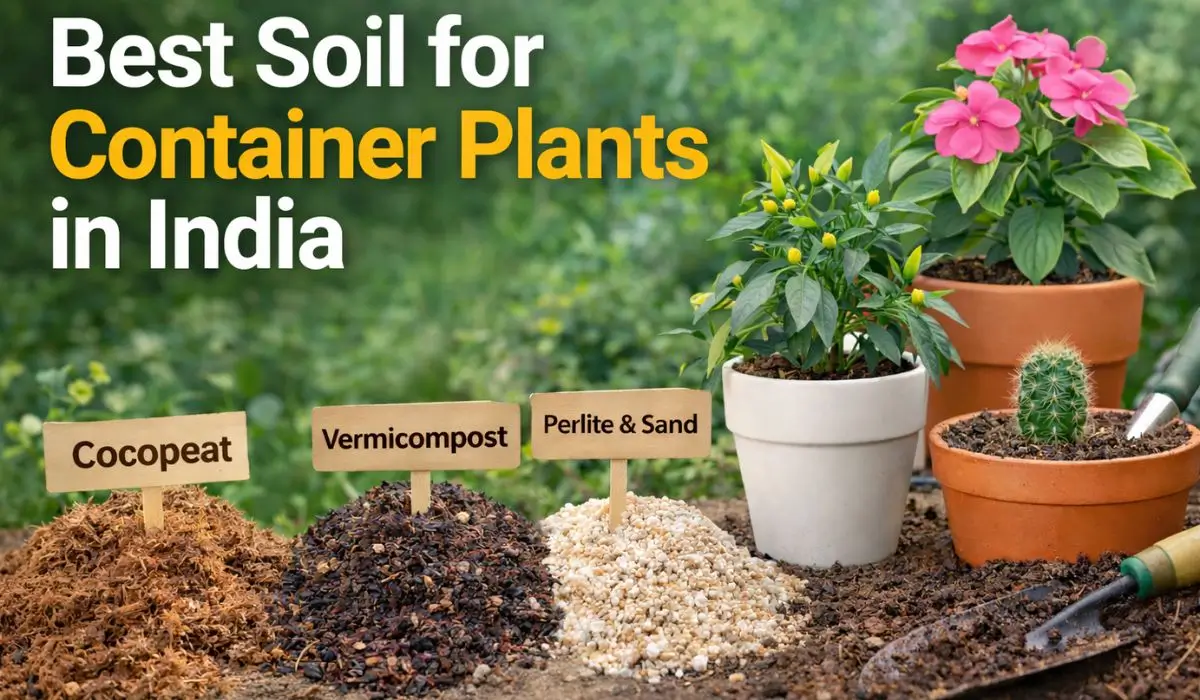
The best soil mix for container plants in India is nothing like the soil you dig up from your garden — and that difference is the reason most balcony plants struggle. Garden soil compacts hard inside a pot, chokes roots, and holds water like a clay brick after every rain. Whether you are growing tomatoes on a Mumbai terrace, mint on a Delhi windowsill, or marigolds in a Bangalore grow bag, the right potting mix makes the difference between a plant that thrives and one that slowly drowns. In this guide, you will learn the exact ratios, the cheapest local ingredients, and how to mix it yourself in under 20 minutes.
Quick facts
| Difficulty | Easy — no special tools needed |
| Time to mix | 15–20 minutes |
| Key ingredients | Cocopeat · Perlite or river sand · Vermicompost |
| Best for | Vegetables, herbs, flowering plants, fruit trees in pots, grow bags, terrace beds |
| Indian climate note | Increase perlite to 30% during monsoon in Mumbai and coastal cities. In Delhi winters, reduce watering frequency — not mix composition. |
Why regular garden soil fails in containers
Pick up a handful of garden soil from a bed and it feels fine — loose, crumbly, workable. Put that same soil in a pot and water it twice, and something changes. It compacts. Air pockets disappear. Roots that need oxygen to absorb water and nutrients find themselves sitting in a dense, suffocating mass.
Indian garden soil makes this worse. Large parts of Maharashtra, Tamil Nadu, and Karnataka have heavy black cotton soil or laterite that is specifically designed — by millions of years of geology — for open ground with unlimited drainage depth. In a 12-inch pot with a drainage hole at the bottom, that soil becomes a water trap. The roots rot. Fungal infections follow. The plant looks overwatered even when you are watering correctly, because the problem is the medium, not the water schedule.
A good container potting mix solves this by replacing density with structure: materials that stay loose, drain freely, and hold just enough moisture for roots to drink without sitting wet.
The 3 core ingredients of a good potting mix
Every reliable container mix for Indian gardens is built from three things. You do not need anything more exotic than this to grow almost any plant successfully in a pot.
Cocopeat is the backbone. Made from the fibrous husk of coconuts — a product India produces in enormous quantities — cocopeat is light, airy, and holds moisture well without becoming waterlogged. It is the reason your mix stays fluffy rather than compacting after a few weeks. A 5 kg brick from a local nursery or from Ugaoo or TrustBasket online costs around ₹100–₹150 and expands to roughly 60–70 litres of loose material when wetted. It is the single most important ingredient in any Indian potting mix.
Perlite or river sand provides drainage. Perlite — white, volcanic, pumice-like granules — is the better of the two because it is light and does not compact over time. River sand works as a budget substitute and is available at any hardware shop. Both serve the same purpose: creating drainage channels so excess water exits quickly after watering.
Vermicompost feeds the plant. Unlike synthetic fertilisers, vermicompost releases nutrients slowly and also improves soil structure. Two to three parts vermicompost in your mix gives most vegetables and flowering plants enough nutrition for their first 4–6 weeks without any additional feeding. KVK (Krishi Vigyan Kendra) outlets across India often sell vermicompost directly at subsidised rates — worth checking before buying online.
Best soil mix ratios for different container plants in India
Different plants have different needs, and a one-ratio-fits-all approach leaves some struggling. Succulents rot in a moisture-retentive vegetable mix; tomatoes starve in a low-nutrient cactus blend. Use this table as your starting point, then adjust slightly based on how your specific variety responds over the first few weeks.
| Plant type | Cocopeat | Perlite / river sand | Vermicompost | Notes |
|---|---|---|---|---|
| Vegetables (tomato, chilli, brinjal) | 50% | 20% | 30% | Nutrient-rich; good drainage for heavy feeders |
| Herbs (tulsi, mint, coriander) | 60% | 20% | 20% | Lighter mix; herbs prefer frequent, light watering |
| Succulents and cacti | 20% | 60% | 20% | Maximum drainage; very low moisture retention |
| Flowering plants (marigold, petunia, zinnia) | 50% | 25% | 25% | Balanced; top-dress with vermicompost monthly |
| Fruit trees in pots (lemon, guava, chikoo) | 40% | 20% | 30% | Add 10% garden soil for root stability in larger pots |
According to ICAR’s guidance on container and kitchen garden vegetable cultivation, well-drained growing media with adequate organic matter is one of the most important factors in container vegetable productivity — a principle that applies equally to flowering and fruiting plants. The ratios above are consistent with that framework, adapted for commonly available Indian ingredients.
How to make the best soil mix for container plants in India — step by step
Making your own potting mix takes about 15–20 minutes and costs a fraction of ready-made bags. Here is the process, using the vegetable ratio (50/20/30) as the example — adjust proportions for your plant type using the table above.
- Gather your ingredients. You need cocopeat (pre-soaked in water until fully expanded), perlite or river sand, and vermicompost. Use a cup or mug as your measuring unit — any consistent unit works.
- Measure the dry ingredients. For every 5 cups of cocopeat, add 2 cups of perlite or river sand and 3 cups of vermicompost. Scale up or down based on how many pots you are filling.
- Mix dry first. Combine all three in a large tray, bucket, or old plastic tub. Stir thoroughly so the vermicompost is evenly distributed — no dark clumps, no white perlite pockets.
- Check moisture. Pre-wetted cocopeat should have brought the mix to a good damp level. Squeeze a handful — it should clump lightly and feel like a wrung-out sponge. If it drips, it is too wet; spread it out for 10 minutes. If it crumbles completely, add a splash of water and mix again.
- Fill your container. Spoon or pour the mix into your pot, grow bag, or raised bed. Fill to about 5 cm (2 inches) below the rim. This gap prevents spillage when watering.
- Plant and water lightly. Make a planting hole, set your seedling or seeds, firm the mix gently around the base, and give a light first watering. Avoid heavy watering for the first 24 hours while roots settle.
From our garden –
In my terrace garden in Pune in June 2024, I switched from a 70% garden soil blend to the 50/20/30 cocopeat-perlite-vermicompost mix for my chilli plants. The difference was visible within two weeks — leaves were a noticeably darker green, and the waterlogging that had rotted two plants the previous monsoon simply did not happen. Even on the days we got 80 mm of rain, the grow bags drained within an hour. The perlite made all the difference.
Adjusting your mix for Indian seasons
The ratios above are a good year-round starting point, but India’s extreme seasonal swings — monsoon waterlogging, summer heat, north Indian dry winters — mean a small seasonal adjustment can meaningfully improve how your plants perform.
Monsoon (June–September): Increase perlite or river sand to 30% in your mix, at the expense of cocopeat, for pots that sit outdoors in Mumbai, Chennai, Kochi, or any high-rainfall coastal city. The extra drainage prevents the roots from sitting in water during heavy spells. Adding a small amount of neem cake powder (roughly 1 tablespoon per pot, mixed into the top 2 inches of soil) also helps suppress the fungal infections that thrive in humid conditions during this period.
Summer (March–June): Heat accelerates nutrient depletion and breaks down organic matter faster. Top-dress your pots with a fresh layer of vermicompost in late March or early April, before temperatures peak, to replenish nutrition without repotting. In cities like Nagpur or Hyderabad where summer temperatures cross 42°C, moving pots to partial shade and increasing watering frequency is more effective than changing the mix.
North Indian winter (November–February): In Delhi, Lucknow, Chandigarh, and similar climates, cold slows plant metabolism and the mix retains moisture much longer than in summer. Reduce your watering frequency, not your mix composition. The same cocopeat-perlite-vermicompost blend works well year-round in these climates — the soil itself does not need seasonal reformulation.
Where to buy potting mix ingredients in India
All three core ingredients are widely available across India, either locally or online.
Cocopeat: Local nurseries stock cocopeat bricks in most cities and towns. Online, Ugaoo, TrustBasket, and Kraft Seeds all deliver reliably across India. A 5 kg compressed brick — which expands to 60–70 litres — costs approximately ₹100–₹150. Buy the compressed brick rather than loose cocopeat in a bag; it is far better value.
Perlite: Metro cities (Mumbai, Delhi, Bangalore, Chennai, Hyderabad, Pune) have garden centres that stock perlite. In smaller towns, Amazon India or Ugaoo are your best options for delivery. A 1 kg bag typically costs ₹80–₹120.
Vermicompost: Available at local nurseries across India. KVK outlets often sell it at subsidised rates. You can also make vermicompost at home — a useful skill if you garden regularly, since it turns kitchen waste into a constant supply of the best organic nutrition for your containers.
Once you have your mix ready, the next step is choosing what to grow. Start with vegetables that grow well in containers — they give you the fastest, most satisfying results with a good potting mix. And if you are just getting started, our complete guide to setting up a balcony garden in India covers everything from pot selection to drainage setup.
Common potting mix mistakes and how to fix them
Even experienced gardeners make these errors. Each one is easy to avoid once you know what to look for.
Using 100% garden soil. This is the most common mistake, especially among beginners. The fix is simple: never fill a pot with soil directly from the ground. Always use a cocopeat-based blend.
Not pre-wetting cocopeat. Dry cocopeat is hydrophobic — it repels water rather than absorbing it. Water poured onto dry cocopeat in a pot simply runs down the sides and out the drainage hole without wetting the mix at all. Always soak the compressed brick in water until it is fully expanded and evenly moist before mixing.
Reusing old mix without refreshing it. Potting mix from last season has depleted nutrients, possible pest eggs or fungal spores, and compacted structure. If reusing, mix in at least 30% fresh vermicompost and 20% fresh cocopeat before putting it back in a pot. For learn how often to water container plants in India — overwatering a depleted old mix is especially damaging.
Skipping the drainage check. Before filling a pot, check that the drainage holes are clear and not blocked. Place a small piece of old mesh or a broken pot shard over the hole to prevent mix from washing out without blocking drainage.
Using too little perlite during monsoon. Many gardeners mix a good blend in spring and forget to adjust when the rains arrive. If your pots are sitting in standing water after heavy rain, repot with an extra 10% perlite mixed in.
Ready-made vs homemade potting mix — which is better for Indian gardens?
Ready-made potting mixes from brands like Ugaoo, TrustBasket, and Kraft Seeds are convenient and reasonably well-formulated. They work. But they come at a cost: a 5 kg bag typically runs ₹300–₹500, which adds up quickly if you are filling ten or twenty pots. Quality also varies between batches, and you have no control over the nutrient content or drainage level.
Homemade mixes, using the ratios in this guide, cost roughly one-third as much per litre, can be customised exactly to your plant types and local climate, and are consistent every time because you control the ingredients. For anyone with more than five pots, homemade is the better choice on every practical measure.
The exception is when you are just starting out with one or two pots and do not yet want to buy three separate ingredients. In that case, a ready-made bag is a perfectly reasonable way to begin. Once you see the results and decide you want to scale up, making your own becomes the obvious next step.
Frequently asked questions
What is the best soil mix for container plants in India?
The best soil mix for container plants in India is 50% cocopeat, 20–30% vermicompost, and 20–30% perlite or river sand. This combination provides drainage, aeration, and nutrition suited to Indian climates. Adjust the perlite ratio upward during the monsoon season to prevent waterlogging in pots and grow bags.
Can I use garden soil in pots?
Regular garden soil is not suitable for pots because it compacts tightly in containers, cutting off oxygen to roots and causing waterlogging. Indian garden soil — often clay-heavy or laterite — is especially problematic in small pots. Always use a loose potting mix with cocopeat and perlite instead.
Is cocopeat good for all container plants in India?
Cocopeat is an excellent base ingredient for most container plants in India — it retains moisture, is lightweight, and is widely available at low cost. However, succulents and cacti need a much lower cocopeat ratio (around 20%) and more sand or perlite for adequate drainage.
How often should I refresh potting mix in containers?
Refresh or replace potting mix every 12–18 months, or whenever the soil stays soggy, drains very slowly, or plants show stunted growth despite regular watering. In Indian summers, mix degrades faster due to heat. Top-dress with vermicompost every 2–3 months as a simpler interim solution.
Where can I buy cocopeat and perlite in India?
Cocopeat is available at most local nurseries across India, and online from Ugaoo, TrustBasket, and Amazon India — a 5 kg brick costs approximately ₹100–₹150. Perlite is easier to find in metro garden centres; smaller towns can order it online. Both are usually in stock year-round.
Start with the right mix and your containers will surprise you
The best soil mix for container plants in India is simpler and cheaper than most gardeners expect: cocopeat for structure and moisture retention, perlite or river sand for drainage, and vermicompost for nutrition. Get those three ingredients in the right ratio for your plant type, adjust slightly for monsoon season, and most of the reasons container plants fail in India simply disappear.
Mix a small batch this weekend. Fill one pot and watch how differently it drains compared to anything you have used before. That difference — water moving freely through the medium, roots never sitting wet — is what makes container gardening in India consistently rewarding rather than consistently frustrating.
Have questions about your specific plants or a mix that is not working? Leave a comment below and we will help you troubleshoot. And if you are ready to put your new mix to work, start with our guide to vegetables that grow well in containers — it pairs directly with everything covered here.







