
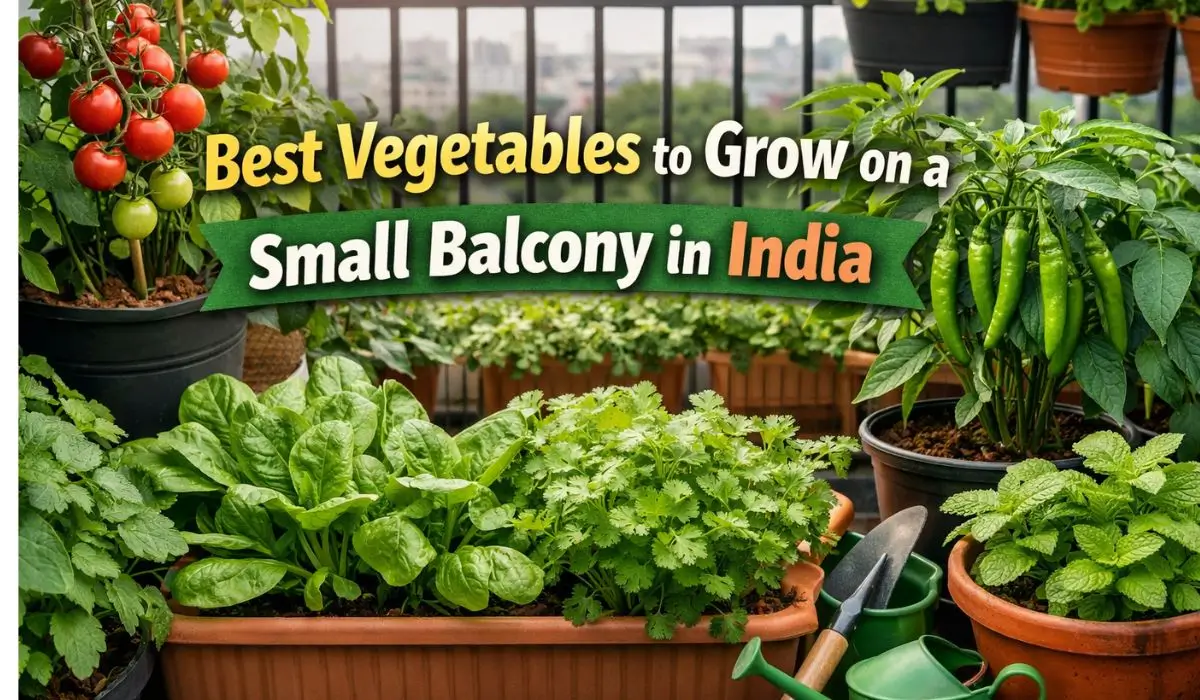
The Best Vegetables to Grow on Balcony in India are spinach, coriander, green chilies, cherry tomatoes, mint, fenugreek, radish, and okra. These plants thrive in containers, require minimal space, and are well-suited to India’s varied climate zones — from the humid heat of Mumbai and Chennai to the dry summers of Delhi and Ahmedabad.
Why Best Vegetables to Grow on Balcony in India Works
India’s urban density has pushed most households into apartments and flats — yet the country’s climate is one of the best in the world for year-round food growing. Most Indian cities receive 6–9 hours of daily sunlight throughout the year. Temperatures rarely drop to the freezing levels that halt growth in European or North American gardens.
A balcony as small as 4 x 3 feet can realistically produce leafy greens, herbs, chilies, and even tomatoes — provided you choose the right vegetables, containers, and soil mix.
This guide focuses specifically on Indian growing conditions: humidity levels, monsoon seasons, summer heat, and the vegetables that Indian kitchens actually use every day.
What You Need Before You Start
Before selecting plants, assess your balcony across three key factors:
Sunlight: Measure how many hours of direct sunlight your balcony receives. South and west-facing balconies generally get 5–8 hours; north-facing balconies may receive 2–3 hours. This directly determines which vegetables you can grow.
Space: Calculate your usable floor and railing space. Include vertical wall space — wall-mounted planters and railing hooks can double your growing area without using floor space.
Wind exposure: High-rise balconies above the 6th floor often experience strong winds that can damage plants and dry out containers rapidly. Wind barriers or placement near walls can help manage this.
Basic Equipment Checklist
| Item | Purpose | Estimated Cost (India) |
|---|---|---|
| Grow bags (12–15 inch) | Root space and drainage | ₹30–80 per bag |
| Potting mix (cocopeat-based) | Nutrient-rich, lightweight soil | ₹200–400 per bag |
| Watering can or drip bottle | Controlled, gentle watering | ₹150–300 |
| Organic compost / vermicompost | Fertilizing and soil enrichment | ₹100–250 |
| Trowel and hand fork | Planting and soil loosening | ₹100–200 |
| Trellis or bamboo sticks | Vertical support for climbing plants | ₹50–150 |
Best Vegetables to Grow on a Balcony in India
The following vegetables have been selected based on four criteria: container adaptability, common use in Indian cooking, performance across India’s climate zones, and ease of growing for beginners.
Spinach (Palak) — Best for Beginners
Why it works: Spinach is one of the fastest-growing leafy vegetables available to Indian home gardeners. It has a shallow root system, meaning it grows well in containers as thin as 6–8 inches deep. It also tolerates partial shade, making it suitable for east-facing or partially covered balconies.
Container size: 6–8 inches deep, any width Sunlight needed: 3–5 hours daily Harvest time: 20–30 days from sowing Best season: October to February (winter); avoid peak summer above 35°C Yield per pot (12-inch): 200–300 grams per harvest cycle
Growing tip: Sow seeds 1 cm deep and 5 cm apart. Water gently every day in dry weather. Harvest outer leaves first to allow continuous regrowth — one pot can give 3–4 harvests before the plant bolts.
Common mistake: Sowing too densely. Overcrowded spinach plants compete for nutrients and produce smaller, weaker leaves. Thin seedlings to 5–8 cm apart once they emerge.
Coriander (Dhaniya) — Daily Kitchen Essential
Why it works: Fresh coriander from a balcony pot tastes dramatically better than store-bought. The plant grows fast, costs almost nothing to start, and can be grown in recycled containers — including old yoghurt tubs and plastic boxes.
Container size: 4–6 inches deep minimum Sunlight needed: 3–4 hours daily Harvest time: 3–4 weeks for leaves; 2–3 months for seeds Best season: October to March; struggles in high humidity monsoon months
Growing tip: Before sowing, lightly crush each coriander seed between your palms to split it into two halves. This significantly improves germination speed and rate. Sow directly into the container — coriander dislikes transplanting.
Common mistake: Expecting coriander to grow through Mumbai’s monsoon or peak summer. It bolts (goes to seed) quickly in heat above 30°C and in high humidity. Treat it as a winter and spring crop.
Green Chilies — High Yield, Compact Plant
Why it works: A single well-maintained chili plant can produce 50–100 chilies over its growing season. The plant is naturally compact, grows well in pots, and thrives in India’s long, hot summers — the exact conditions that many other vegetables struggle with.
Container size: 10–12 inches deep, 10 inches wide Sunlight needed: 6–8 hours daily Harvest time: 60–75 days from transplant (start from seedlings, not seed, for faster results) Best season: February to June; also August to November
Growing tip: Once your chili plant reaches 15–20 cm height, pinch the growing tip. This encourages bushier growth and significantly increases the number of fruit-bearing branches.
Common mistake: Overwatering. Chili roots are highly susceptible to rot in waterlogged soil. Water only when the top 2 cm of soil is dry. Ensure your container has drainage holes.
Cherry Tomatoes — Compact, Prolific, and Rewarding
Why it works: Standard tomato varieties grow too large for most balconies. Cherry tomato cultivars — such as Pusa Cherry 1 (developed by ICAR) and hybrid cherry varieties available at Indian nurseries — are compact, grow to 40–60 cm, and produce abundant fruit in containers.
Container size: 12–15 inches deep, 12 inches wide minimum Sunlight needed: 6–8 hours daily Harvest time: 70–90 days from transplant Best season: October to February in South India; August to November in North India
Growing tip: Install a bamboo stake or small tomato cage at planting time — not after the plant grows, when roots can be disturbed. As the plant grows, loosely tie stems to the support every 15–20 cm using soft twine or torn cloth strips.
Common mistake: Inconsistent watering. Irregular watering causes blossom end rot and fruit splitting in tomatoes. Aim for consistent moisture — not waterlogged, not bone dry.
Mint (Pudina) — The Most Resilient Balcony Plant
Why it works: Mint is virtually indestructible. It can be grown from 5 cm stem cuttings placed in water, then transferred to soil once roots appear. It tolerates heat, partial shade, and irregular watering better than almost any other edible plant.
Container size: 8–10 inches wide and deep Sunlight needed: 2–4 hours daily (partial shade acceptable) Harvest time: 3–4 weeks from cutting Best season: Year-round; slows in extreme summer heat
Important: Always grow mint in its own separate container. Mint spreads aggressively through underground runners and will crowd out other plants if grown together.
Growing tip: Harvest regularly — cut stems down to 5 cm above soil. Regular harvesting keeps the plant compact and productive. Without harvesting, mint becomes leggy and loses flavour intensity.
Fenugreek (Methi) — Fastest-Growing Edible on Your Balcony
Why it works: Fenugreek is the fastest-growing edible vegetable you can grow on an Indian balcony. Seeds germinate within 2–3 days, and the first harvest of tender leaves is ready in 15–20 days. It requires minimal soil depth and almost no maintenance.
Container size: 4 inches deep (can grow in a lunchbox or flat tray) Sunlight needed: 3–5 hours daily Harvest time: 15–20 days for microgreens; 25–30 days for full leaves Best season: October to February
Growing tip: Sow seeds densely (unlike most vegetables). Fenugreek is harvested by cutting the whole plant close to the soil, then allowing regrowth for a second cut. A 12-inch container can give 2–3 harvests before productivity drops.
Radish (Mooli) — Quick-Turnover Crop for Winter
Why it works: Radish matures faster than almost any root vegetable, making it ideal for impatient growers and for filling gaps between other seasonal crops. It grows well in Indian winters and produces harvestable roots in under a month.
Container size: 10–12 inches deep (root vegetables need more depth than leafy greens) Sunlight needed: 4–6 hours daily Harvest time: 25–35 days Best season: October to January
Growing tip: Thin seedlings to at least 5 cm apart once they reach 5 cm height. Crowded radishes produce thin, forked, or unmarketable roots. The thinned seedlings can be eaten as microgreens.
Note on size: Balcony-grown radishes are typically smaller than farm-grown ones. This is normal with container growing and does not affect flavour — most home gardeners find them more tender and flavourful than store-bought.
Okra / Ladies Finger (Bhindi) — Summer Powerhouse
Why it works: Bhindi is one of the most heat-tolerant vegetables available, making it perfect for Indian summers when most other vegetables fail. It grows vertically, fitting well into narrow balcony spaces, and produces continuously once it begins fruiting.
Container size: 12–15 inches deep, 12 inches wide (bhindi has a deep taproot and cannot be grown in shallow containers) Sunlight needed: 7–8 hours daily Harvest time: 50–60 days from sowing Best season: March to June; also July to September
Growing tip: Harvest bhindi pods when they are 6–8 cm long. If left on the plant too long, pods become fibrous and tough — and the plant reduces production. Check plants every 2 days during peak fruiting.
Bottle Gourd / Lauki — For Larger Balconies
Why it works: If your balcony has a railing or overhead structure, bottle gourd can be trained to climb vertically and produce heavy yields from just 1–2 plants. It is one of the most space-efficient ways to grow a large vegetable on a balcony.
Container size: 18–24 inches deep, large grow bag or bucket Sunlight needed: 7–8 hours daily Harvest time: 60–70 days Best season: February to June
Growing tip: Train the main vine along a rope or wire attached to the railing or ceiling. This keeps the fruit off the ground and makes harvesting easy. Use cloth strips to support heavy developing fruits to prevent them from pulling the vine down.
Seasonal Planting Calendar for Indian Balcony Gardeners
India’s three distinct growing seasons determine what you can successfully grow at any given time. Planting with the season — rather than against it — dramatically improves yield and reduces plant stress.
Winter Season (October – February)
This is the best growing season for most vegetables in India. Temperatures are moderate, pests are less active, and leafy greens, root vegetables, and brassicas thrive.
Best crops: Spinach, coriander, fenugreek, radish, carrot, peas, lettuce, cabbage, cauliflower (larger containers required for brassicas)
Summer Season (March – June)
Heat-loving vegetables dominate this season. Most leafy greens bolt and become bitter. Focus on fruiting vegetables that need extended warmth to produce.
Best crops: Okra, green chilies, tomatoes, ridge gourd, bitter gourd, cucumber, snake gourd, cluster beans
Monsoon Season (July – September)
Monsoon gardening requires extra attention. Waterlogging is the primary challenge. Elevate containers slightly for better drainage, and avoid overwatering since natural rainfall will be supplementing.
Best crops: Spinach, amaranth (lal saag), beans, bitter gourd, curry leaf (plant not vegetable), basil
Choosing the Right Containers
Container selection is one of the most consequential decisions in balcony gardening. The wrong container limits root growth, causes waterlogging, or overheats roots in summer — all of which reduce yield.
Grow bags: The most recommended container type for Indian balcony gardeners. They are lightweight (important for balcony load limits), breathable (prevents root rot), inexpensive, and available in every nursery and on Amazon India. 12-litre and 20-litre sizes cover most vegetables.
Terracotta pots: Excellent for herbs and smaller plants. Porous walls allow air and moisture exchange, which benefits root health. However, they are heavy and break in falls, and they dry out faster in summer — requiring more frequent watering.
Plastic pots: Affordable, lightweight, and durable. The main downside is reduced breathability, which increases waterlogging risk if drainage holes are insufficient. Always use plastic pots with at least 3–4 drainage holes at the base.
Recycled containers: Old buckets, plastic crates, paint containers, and wooden crates all work. Drill drainage holes in the base before use.
Container Depth Guide by Vegetable Type
| Vegetable Type | Minimum Depth | Examples |
|---|---|---|
| Microgreens & herbs | 4–6 inches | Fenugreek, coriander, mint |
| Leafy greens | 6–8 inches | Spinach, amaranth, lettuce |
| Fruiting vegetables | 10–12 inches | Chilies, tomatoes, eggplant |
| Root vegetables | 10–14 inches | Radish, carrots, beetroot |
| Climbing vegetables | 15–18 inches | Okra, bottle gourd, beans |
Best Soil Mix for Balcony Vegetables in India
Standard garden soil is unsuitable for container growing. It compacts over time, restricts root growth, and does not drain adequately in pots. A good potting mix must be lightweight, nutrient-rich, and free-draining.
Recommended Potting Mix Recipe (DIY)
Combine the following by volume:
- 40% cocopeat — lightweight, retains moisture evenly, excellent drainage
- 30% compost or vermicompost — provides slow-release nutrients
- 20% garden soil — adds weight and microbial life
- 10% perlite or river sand — improves drainage and aeration
This mix is suitable for all the vegetables listed in this guide. Refresh or replace potting mix every 12–18 months, as nutrients deplete and cocopeat breaks down over time.
Ready-made option: Several Indian brands (Ugaoo, TrustBasket, Kraft Seeds) sell pre-mixed potting soil suitable for container vegetables. These are a reliable option for beginners.
Sunlight Requirements by Vegetable
Sunlight is the single most important variable in balcony gardening. Matching your plants to your balcony’s light availability prevents the frustration of plants that survive but never produce.
Low Light (2–4 hours direct sun)
Suitable crops: Mint, spinach, fenugreek, coriander These crops will grow with indirect or partial light but will produce more slowly than in full sun.
Medium Light (4–6 hours direct sun)
Suitable crops: Radish, lettuce, amaranth, beans, peas, curry leaf Standard productivity. Most leafy greens perform well in this range.
Full Sun (6–8+ hours direct sun)
Required crops: Tomatoes, chilies, okra, bottle gourd, cucumber, bitter gourd Without adequate sun, fruiting plants produce flowers but set little or no fruit.
Tip for low-light balconies: Use reflective surfaces (white-painted walls, silver foil panels) to bounce additional light onto plants. This can increase effective light by 20–30%.
Watering Guide for Container Vegetables
Incorrect watering — particularly overwatering — is the leading cause of plant death in balcony gardens. Container plants have no access to groundwater and rely entirely on what you provide, but they are also far more vulnerable to waterlogging than in-ground plants.
The Finger Test
Before watering any container, insert your finger 2–3 cm into the soil. If it feels moist, wait. Water only when the top 2 cm of soil is dry to the touch.
General Watering Frequency Guide
| Season | Frequency |
|---|---|
| Winter (Oct–Feb) | Every 2–3 days |
| Summer (Mar–Jun) | Daily, or twice daily for small containers in peak heat |
| Monsoon (Jul–Sep) | Only when not raining; check soil before watering |
Signs of Overwatering
- Yellowing lower leaves
- Soggy, heavy soil that does not dry between waterings
- Mould on soil surface
- Wilting despite moist soil (root rot)
Signs of Underwatering
- Dry, cracked soil surface
- Wilting in the afternoon that does not recover after evening
- Crispy leaf edges
- Lightweight container
Water quality note: If your tap water is very chlorinated (common in many Indian cities), fill your watering can and let it sit for 30–60 minutes before use. Chlorine dissipates with exposure to air and sunlight.
Fertilizing Balcony Plants Organically
Container plants exhaust soil nutrients faster than in-ground plants because water flushes nutrients through drainage holes over time. Regular fertilizing is necessary for sustained productivity.
Organic Fertilizer Options Available in India
Vermicompost: The most versatile and widely available organic fertilizer in India. Apply 1–2 handfuls per pot every 3–4 weeks. Works as a top dressing — just spread over the soil surface.
Neem cake (neem khali): A byproduct of neem oil extraction. Rich in nitrogen and also acts as a natural pest deterrent. Mix into the top layer of soil or use as a top dressing every 4–6 weeks.
Banana peel liquid fertilizer: Soak 3–4 banana peels in 1 litre of water for 48 hours. Dilute 1:5 with water and apply to the soil. Provides potassium, which supports flowering and fruiting in tomatoes and chilies.
Cow dung compost (gobar khad): Widely available and highly effective. Mix into potting soil at a ratio of 10–15% by volume, or use as a top dressing every 3–4 weeks.
What to avoid: Chemical fertilizers like DAP and urea are effective but make it difficult to maintain organic produce. They also tend to cause nutrient burn in containers if over-applied. For home food growing, organic inputs are safer and more sustainable.
Common Mistakes Balcony Gardeners Make in India
Using Garden Soil Directly in Pots
Garden soil compacts in containers and restricts root growth. It also often contains weed seeds and pathogens. Always use a lightweight potting mix, not soil dug from a garden or roadside.
Choosing the Wrong Plants for Available Light
Planting tomatoes and chilies on a north-facing balcony that receives 2 hours of sun will produce leggy, non-fruiting plants. Assess your sunlight honestly before selecting vegetables.
Neglecting Drainage
Pots without drainage holes or pots placed in trays that collect and hold water cause root rot within days. Always ensure water can drain freely from every container.
Planting Too Many Varieties at Once
Starting with 8–10 different vegetables simultaneously means managing different watering schedules, fertilizer needs, and pest vulnerabilities at the same time. Start with 2–3 varieties, master them, then expand.
Ignoring the Season
Trying to grow spinach in June in Delhi, or tomatoes in January in Shimla, will fail regardless of how well you care for the plants. Season alignment is non-negotiable.
Skipping Thinning
Most vegetables require thinning — removing excess seedlings after germination so remaining plants have space to grow. Skipping this step leads to weak, overcrowded plants with poor yields.
Over-fertilizing
More fertilizer does not mean more yield. Excess nitrogen causes abundant leaf growth at the expense of flowers and fruit. Stick to the recommended application rates and intervals.
Frequently Asked Questions
What are the easiest vegetables to grow on a balcony in India for beginners?
Mint, fenugreek, and spinach are the easiest starting points. All three germinate quickly, tolerate partial shade, forgive irregular watering, and are useful in daily Indian cooking. Beginners can expect their first harvest within 3–4 weeks.
Can I grow vegetables on a balcony without direct sunlight?
Yes, with limitations. Leafy greens and herbs — spinach, mint, coriander, fenugreek — can grow and produce in indirect light or 2–3 hours of direct sun. Fruiting vegetables (tomatoes, chilies, okra) require a minimum of 6 hours of direct sunlight to set fruit and are not suitable for deeply shaded balconies.
How many pots can I fit on a small balcony?
A 4 x 3 foot balcony can typically accommodate 8–12 pots when combining floor containers, railing planters, and one tier of wall-mounted or hanging pots. Vertical space is the key multiplier in small balcony gardens.
Which containers are best for balcony gardening in India?
Grow bags are the best all-round choice for Indian balcony gardeners — lightweight, breathable, inexpensive, and available everywhere. For herbs and smaller plants, terracotta pots offer excellent drainage and aeration. Avoid deep, narrow containers, which restrict air circulation.
What is the best potting mix for balcony vegetables in India?
A mix of 40% cocopeat, 30% compost, 20% garden soil, and 10% perlite or sand performs well for all vegetables listed in this guide. Ready-mixed potting soils from brands like Ugaoo or TrustBasket are reliable commercial alternatives.
How often should I water balcony plants in Indian summers?
In peak summer (April–June), small containers may need watering daily or even twice daily in very hot, dry conditions. Always use the finger test — water only when the top 2 cm of soil is dry — rather than watering on a fixed schedule.
Can I grow vegetables on a high-rise apartment balcony in India?
Yes, but wind exposure increases significantly above the 4th–5th floor. Use heavier grow bags, stake plants securely, and position containers near walls or corners that provide natural wind protection. Choose compact, low-growing varieties over tall or climbing plants for high-rise balconies.
Is balcony gardening viable during monsoon in India?
Yes. Monsoon season supports a specific set of crops — amaranth, beans, bitter gourd, and spinach. The main management challenge is waterlogging. Elevate pots slightly above the floor, ensure drainage holes are clear, and water only when soil is genuinely dry.
Do balcony vegetables need fertilizer?
Yes. Container soil depletes faster than in-ground soil because nutrients leach out through drainage water. Apply vermicompost or neem cake every 3–4 weeks throughout the growing season for consistent yields.
What is the best vegetable to grow on a balcony in India in summer?
Okra (bhindi) and green chilies are the most reliable summer balcony crops in India. Both love intense heat, grow well in containers, and produce continuously through the hottest months when leafy greens and root vegetables fail.
Key Takeaways
Growing vegetables on a balcony in India is practical, economical, and achievable with limited space. The most important principles are:
- Match your plant selection to your available sunlight — this is the most critical variable
- Use a lightweight, well-draining potting mix, not garden soil
- Grow with the season, not against it
- Start with 2–3 beginner-friendly crops before scaling up
- Water based on soil condition, not a fixed schedule
With the right approach, even a 20-square-foot balcony in the heart of Mumbai, Delhi, or Bangalore can produce meaningful quantities of fresh vegetables throughout the year.







