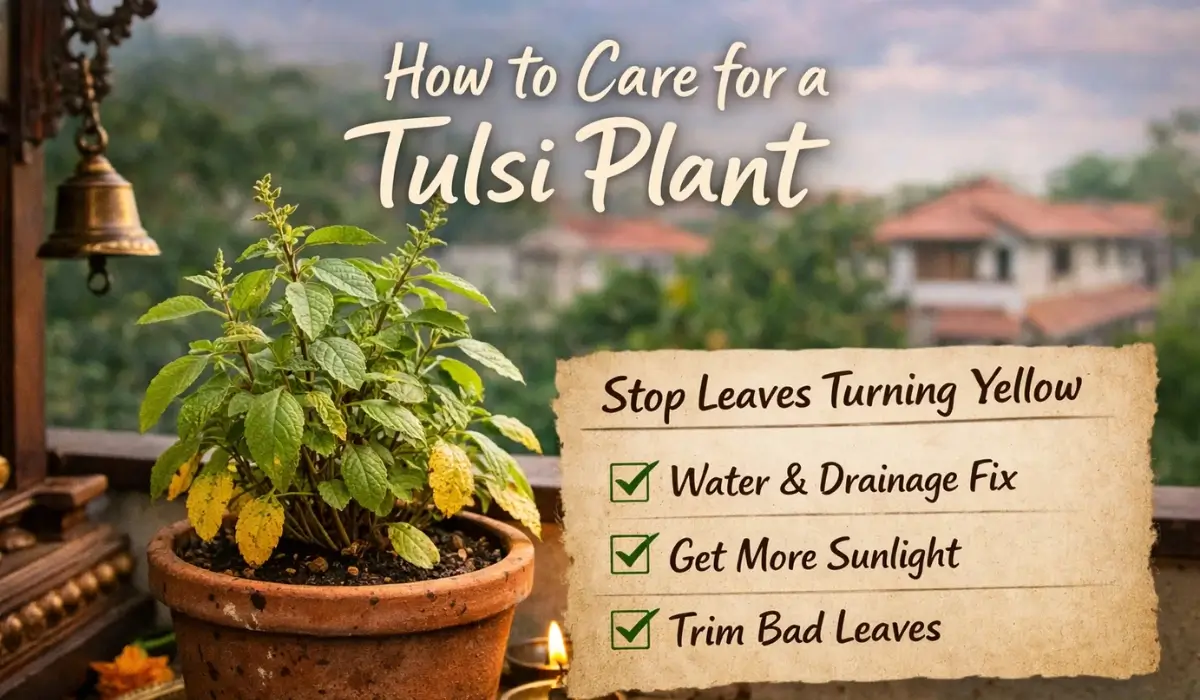
If your Tulsi plant’s leaves are turning yellow, the problem is usually not complicated. In most homes, it comes down to too much water, poor drainage, not enough sun, or tired soil. Tulsi is a strong plant, but it hates sitting in wet soil for too long. Fix the roots first, and the leaves usually follow.
- Don’t water Tulsi on autopilot
- Give it real sunlight, not just a bright room
- Use loose soil and a pot with drainage holes
- Remove yellow leaves and check for pests
- Feed lightly if the plant looks pale and exhausted
There’s something about Tulsi that makes people extra careful with it. They protect it, water it often, move it around, worry over every leaf.
And honestly, that’s sometimes the problem.
I’ve seen Tulsi decline not because it was ignored, but because it was fussed over too much. A little too much water. A little too much shade “to protect it.” A pot with poor drainage. It starts slowly. Then one morning you notice it: two yellow leaves, then five, then the whole plant just looks tired.
Let’s break down what’s actually going on.
Why are Tulsi leaves turning yellow?
Most of the time, yellow Tulsi leaves mean the roots are stressed.
That stress usually comes from one of these:
- overwatering
- soil that stays wet too long
- too little direct sunlight
- nutrient deficiency
- pests hiding under the leaves
- sudden weather shifts
Here’s the thing: a yellow leaf is not the real problem. It’s the signal.
The real issue is usually happening lower down — in the soil, the roots, or the overall growing conditions.
The most common reason: too much water
This is where most people slip up.
Tulsi likes moisture, yes. But it does not like soggy soil. If the pot stays wet for too long, the roots stop breathing properly. Then the leaves begin to yellow, soften, and eventually drop.
A lot of people see yellow leaves and think, “The plant looks dry, I should water more.”
That makes it worse.
Signs your Tulsi may be overwatered
- yellow leaves that feel soft
- drooping even when the soil is wet
- a musty or sour smell from the pot
- blackening near the base of the stem
- slow growth despite regular watering
A simple test works better than any schedule: push your finger into the top inch of soil. If it still feels damp, leave it alone.
How often should you water a Tulsi plant?
There isn’t one perfect schedule, and that’s the truth nobody likes because schedules feel easier.
Watering depends on:
- pot size
- sunlight
- season
- airflow
- soil type
- whether the plant is indoors or outdoors
In summer, Tulsi may need water more often. During monsoon or cool weather, much less. A small terracotta pot on a sunny balcony dries out much faster than a plastic pot in a shaded corner.
A better rule is this: water when the top layer feels dry, not when the calendar says so.
That one change solves a lot of yellow leaf problems.
Tulsi needs more sunlight than people think
A bright room is not the same as sunlight.
That’s one of the biggest indoor plant mistakes in general, and Tulsi is no exception. It wants warmth and proper light. If it sits in a dim indoor corner, it may survive for a while, but it won’t really thrive.
You’ll usually notice:
- pale leaves
- weak, stretched stems
- slower growth
- smaller leaves
- a generally washed-out look
Tulsi does best with at least 4 to 6 hours of sunlight, and in many homes, morning sun is ideal. If your plant gets only indirect light all day, I’d look there first.
Soil can quietly ruin the plant
Now, this part catches people off guard.
Even if your watering is “correct,” the soil may still be holding too much moisture. If the mix is heavy, compacted, or clay-like, Tulsi roots struggle. Water stays trapped. Air circulation drops. The roots sit in a wet blanket.
That’s where problems start.
Tulsi usually does better in light, loose, fast-draining soil. A simple potting mix with a bit of compost and something airy like perlite or coarse sand works much better than dense garden soil shoved into a pot.
If water pools on top or drains very slowly, the soil needs help.
How to stop yellow leaves on Tulsi
If your Tulsi is already yellowing, don’t panic. You probably do not need some exotic plant tonic. You need a reset.
1. Stop watering for a bit
If the soil is wet, let it dry slightly before watering again. Not bone dry. Just not constantly damp.
2. Move it somewhere brighter
A sunny balcony, terrace edge, or window with actual direct sun usually helps more than people expect.
3. Check the drainage holes
If the pot doesn’t drain properly, nothing else will fully work.
4. Remove badly yellow leaves
They usually won’t turn green again. The plant’s energy is better spent on new growth.
5. Loosen or replace the soil if it feels compacted
Sometimes the issue is not the watering amount — it’s that the soil never dries well.
6. Feed lightly if the plant looks pale
If the leaves are light yellow and growth is weak, the soil may simply be exhausted. A little compost or mild balanced fertilizer can help.
7. Check under the leaves
Aphids, mites, and whiteflies love hiding there. If the leaves are sticky, curled, speckled, or patchy, inspect closely.
Can yellow Tulsi leaves turn green again?
Usually, no.
Once a leaf has turned fully yellow, it rarely becomes healthy green again. What you’re looking for is healthy new growth. That’s the real sign your Tulsi is recovering.
This is important because people often keep staring at the damaged leaves and assume the fix isn’t working. But old damage is old damage. Watch the new shoots.
A real-life Tulsi mistake people make at home
I’ve seen this pattern so many times.
Someone keeps Tulsi in a decorative pot without proper drainage. They water every morning because it feels like the responsible thing to do. The plant gets light, but not actual sun. After a week or two, the lower leaves start yellowing. Then they add more water because the plant “looks weak.”
That loop kills more Tulsi than neglect does.
Be careful here — Tulsi usually responds better to consistency than constant attention.
Should you prune a Tulsi plant?
Yes, and it helps more than people realize.
Pinching the tips encourages bushier growth. Removing flower spikes can also help the plant keep producing leaves instead of shifting energy into flowering. If your Tulsi has become tall, leggy, and sparse, pruning is often part of the fix.
Also, remove:
- yellow leaves
- spotted leaves
- weak stems
- anything clearly dead or mushy
Just don’t strip the plant aggressively in one go.
Quick Tulsi yellow leaf diagnosis table
| What you see | Likely cause | What to do |
|---|---|---|
| Soft yellow leaves + wet soil | Overwatering | Let soil dry, reduce watering |
| Pale plant + thin stems | Low sunlight | Move to sunnier spot |
| Older leaves yellow first | Nutrient deficiency | Add mild feed or compost |
| Yellow leaves + sticky residue | Pests | Inspect and treat |
| Plant declining after rain | Waterlogged roots | Improve drainage fast |
Best daily care routine for Tulsi
Tulsi does best with a routine that’s simple and repeatable.
- Give it morning sunlight
- Water only when the topsoil starts drying
- Keep it in a well-draining pot
- Feed lightly once in a while, not heavily
- Remove yellow leaves regularly
- Prune tips to keep it bushy
- Watch closely during rainy or humid weather
That’s it.
Not complicated. Just consistent.
FAQs
Why is my Tulsi yellow even though I water it every day?
Daily watering may be the reason. Tulsi often turns yellow when the roots stay too wet for too long. Check the soil before watering instead of following a fixed routine.
Should I keep Tulsi indoors or outdoors?
Tulsi usually does better outdoors in a sunny, airy spot. Indoors can work too, but only if the plant gets strong light from a bright window and isn’t tucked into a dim corner.
Can I save a Tulsi plant with yellow leaves?
Yes, in many cases you can. Fix the watering, improve the drainage, increase sunlight, and remove damaged leaves. Recovery usually shows up in fresh green growth, not in the old yellow leaves.
Is rainwater bad for Tulsi?
Not necessarily. The bigger problem is when rain keeps the soil wet for too long and the pot doesn’t drain well. During long wet spells, Tulsi can struggle badly in heavy soil.