Are your hydroponic yields falling short of their full potential? Many growers struggle to maximize their harvests, often overlooking the critical role of precise hydroponic pruning and training techniques. This guide will transform your approach, showing you how to cultivate healthier, more productive plants and achieve unparalleled yields with every crop.
Why Pruning and Training are Crucial for Hydroponic Yields?
The accelerated growth rates inherent in hydroponic systems make strategic pruning and training not just beneficial, but absolutely essential for optimal plant development and harvest quantity. As Oklahoma State University Extension emphasizes, “Growth rates are generally higher in hydroponics. Without regular pruning, excessive growth, which is very hard to manage, can occur.” This uncontrolled growth leads to a cascade of problems that directly impact your final yield.
In practice, proper hydroponic growth management ensures that your plants direct energy where it matters most: to fruit and flower production, not wasted foliage. It also significantly improves hydroponic plant health by enhancing critical environmental factors within your grow space. For instance, removing excess leaves improves air circulation, which drastically reduces the risk of mold and mildew, common issues in dense canopies.
Furthermore, effective plant canopy management ensures that every part of your plant receives adequate light, a fundamental driver of photosynthesis and subsequent growth. Without it, lower branches become unproductive, contributing to a lower overall yield. Ultimately, these practices are foundational for any serious yield optimization hydroponics strategy, leading to stronger plants and more abundant harvests.
Understanding Hydroponic Plant Training Techniques
Plant training techniques are all about manipulating growth patterns to optimize light exposure and canopy structure. As A-Grade Hydroponics aptly notes, these methods are “all designed with the same goal: increasing yield, canopy efficiency and flower quality.” For hydroponic growers, these techniques are non-negotiable for achieving maximum potential.
Low Stress Training (LST) Hydroponics
Low Stress Training, or LST, involves gently bending and securing branches to encourage horizontal growth rather than vertical. This simple yet powerful method creates a more even canopy, allowing light to penetrate to lower bud sites that would otherwise be shaded. It’s a fantastic technique for beginners because it minimizes stress on the plant, fostering consistent growth and promoting more uniform development across the plant, which directly impacts hydroponic yield optimization strategies.
Sea of Green (SOG) Hydroponics
The Sea of Green (SOG) method focuses on growing many small plants in close proximity, forcing them to mature quickly and produce a single main cola. This technique is ideal for maximizing space and achieving rapid turnarounds. With SOG, you’re essentially harvesting sooner and more frequently, making efficient use of your grow area. While it requires a higher plant count, the reduced vegetative time can lead to impressive annual yields.
Screen of Green (SCROG) Hydroponics
In contrast to SOG, the Screen of Green (SCROG) technique uses a net or screen to spread out a few larger plants, creating an even, horizontal canopy. As branches grow through the screen, you weave them horizontally, ensuring every potential bud site receives direct light. This method is excellent for maximizing the yield of individual plants and is highly effective for managing plant size and optimizing light absorption, especially in limited spaces. For a deeper dive into general plant training principles, you might find our guide on How to Train Young Fruit Trees insightful, as many core concepts apply.
The choice between SCROG vs SOG hydroponics often comes down to your plant count, desired turnaround time, and available space. Both are effective SOG SCROG LST hydroponics strategies for enhancing light distribution and maximizing yield.
Essential Hydroponic Pruning Techniques for Optimal Growth
Pruning is the strategic removal of plant parts to redirect energy, improve air circulation, and encourage stronger, more productive growth. It’s an art and a science, and mastering it is crucial for yield optimization hydroponics.
Topping and Fimming for Bushier Growth
Topping involves removing the main growing tip of a plant, which forces the plant to develop two new main stems from the nodes directly below the cut. This creates a bushier plant with multiple colas, improving light distribution and overall yield. It’s a foundational technique for many growers aiming to increase bud sites. Our Grow Organic Vegetables in Containers guide touches on similar principles of plant management.
Fimming (short for “F***, I Missed”) is a variation where you remove about 75% of the main growing tip, rather than a clean cut. This often results in 3-5 new shoots emerging from the single node, leading to an even bushier plant than topping. Both topping and fimming are key components of any comprehensive hydroponic plant topping guide.
Strategic Defoliation for Airflow and Light Penetration
Defoliation is the removal of excess fan leaves, particularly those that are large, old, yellowing, or shading potential bud sites. This practice significantly improves airflow around the plant, reducing humidity and the risk of fungal diseases. It also allows more light to reach lower branches, encouraging the development of secondary growth and increasing overall photosynthetic efficiency. When defoliating, experts advise that growers should “take no more than 10 to 20 percent of a plant’s foliage at a time” to prevent excessive stress and allow for regrowth.
Remember, the goal of trimming hydroponic plants is not simply to remove foliage, but to sculpt the plant for maximum productivity and health. Each cut should be purposeful, aiming to improve light penetration, air circulation, and nutrient allocation.
Crop-Specific Pruning & Training Calendars for Max Yields
While general principles apply, the best crop-specific pruning and training methods vary significantly depending on what you’re growing. Tailoring your approach ensures each plant type reaches its maximum potential.
Hydroponic Tomatoes and Peppers
For indeterminate tomato types, proper pruning and trellising are paramount; without them, 50% of the tomato yield can be reduced. A common practice for pruning hydroponic tomatoes for maximum yield is to “maintain one main stem, and remove all suckers (side shoots)” that emerge between the main stem and leaf branches. This directs the plant’s energy into fruit production rather than vegetative growth. For sweet peppers, consider removing the stem tip after it reaches approximately 15 inches. Then, alternate between removing inner and outer side shoots to create an open, productive structure that supports heavy fruit loads.
Leafy Greens and Herbs
When growing hydroponic lettuce, spinach, or basil, when to prune hydroponic lettuce and other greens is crucial for continuous harvesting. Instead of harvesting the entire plant, remove only the outer leaves. This allows the inner leaves to continue growing, providing a steady supply over time. For basil and other bushy herbs, pinch back the top growth just above a set of leaves. This encourages the plant to branch out, leading to a denser, more productive plant rather than a tall, leggy one.
Hydroponic Cucumbers and Strawberries
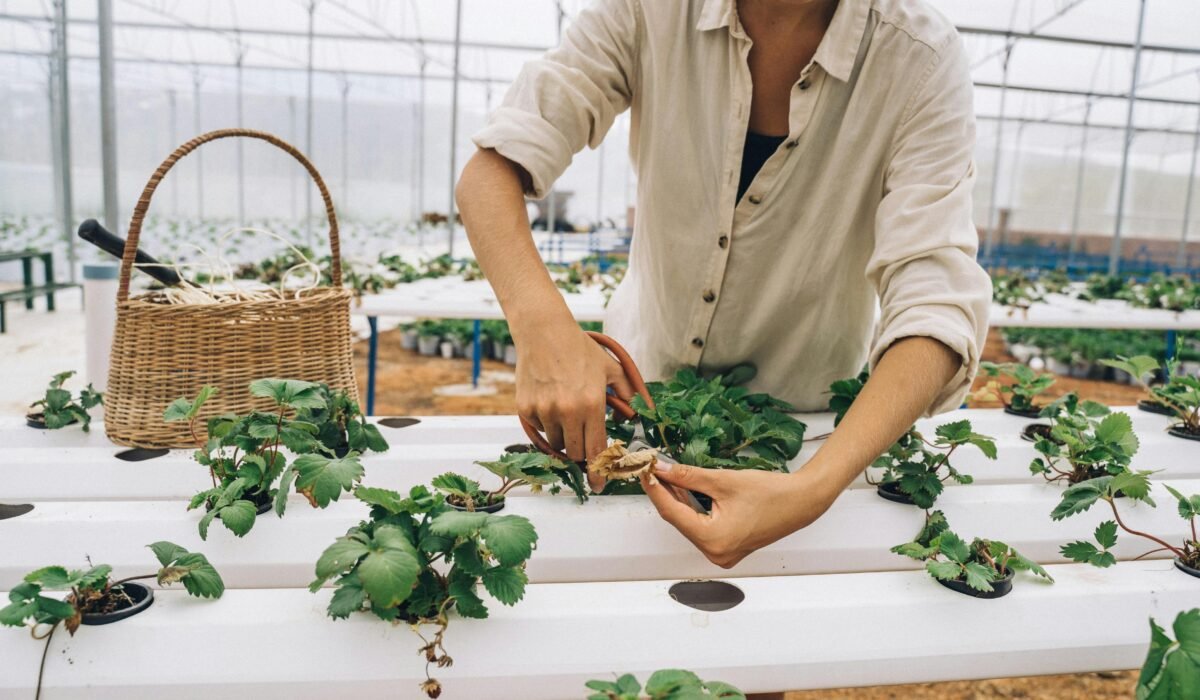
Cucumbers are vigorous growers that benefit immensely from training. Trellis your cucumber plants vertically and prune side shoots to manage their sprawling nature. Remove any yellowing or diseased leaves promptly to maintain hydroponic plant health. For hydroponic strawberries, focus on removing runners (stolons) that aren’t intended for propagation. This directs the plant’s energy into producing larger, sweeter fruits rather than creating new daughter plants, which is a key element of hydroponic yield optimization strategies for berries.
Advanced Hydroponic Training Methods: Super Cropping & Main-lining
Beyond the basics, advanced techniques like super cropping and main-lining offer experienced growers even greater control over plant structure and yield potential. These methods require a bit more finesse but can deliver impressive results.
Super Cropping: Controlled Stress for Enhanced Yields
Super cropping involves intentionally damaging the inner fibers of a branch without breaking the outer skin. You gently pinch and bend a branch until you feel it soften and give way, then secure it in a horizontal position. This controlled stress triggers a powerful healing response in the plant, leading to a thickened “knuckle” at the bend. This knuckle becomes a superhighway for nutrients, often resulting in larger, more potent flowers or fruits on that particular branch. It’s a high-stress technique, so it should be done on healthy, vigorous plants in their vegetative stage.
Main-lining (Manifolding): The Art of Structural Symmetry
Main-lining, also known as manifolding, is a technique that creates a symmetrical, even “manifold” of branches from a single main stem. It involves topping the plant early to create two main branches, then repeating the topping process on those branches to create an even number of colas (typically 8 or 16). The goal is to establish a strong, central hub that distributes energy evenly to all main branches, leading to uniform growth and maximized yield across the entire plant. This method requires careful planning and consistent pruning but rewards you with an incredibly efficient and high-yielding plant structure.
Both super cropping and main-lining are powerful hydroponic pruning and training techniques that elevate your growing game, allowing for precise control over plant architecture and resource allocation.
Leveraging Technology for Smart Hydroponic Yield Optimization
Modern hydroponics isn’t just about water and nutrients; it’s increasingly about data and precision. Integrating technology into your pruning and training strategy offers a significant edge in yield optimization hydroponics.
Smart sensors can monitor critical environmental factors like light intensity, humidity levels, and even plant growth rates in real-time. This data provides invaluable insights, allowing you to make informed decisions about when and how to prune or train. For example, consistent monitoring might reveal that a specific section of your canopy is consistently underperforming due to shading, prompting a targeted defoliation. The rise of vertical farming, which saw systems with an average of 7.2 layers per tower in 2024, has contributed to a 22% increase in yield per square meter since 2020, a testament to optimized spatial management and technology.
Furthermore, advanced systems, including those used in aeroponic yield increase projects, can utilize AI and machine learning to analyze growth patterns and even suggest optimal pruning schedules. Aeroponic systems themselves are designed to increase yield per square meter by approximately 400%, as demonstrated by Aerospring Hydroponics’ commercial pilot project in Sharjah, UAE. This level of data-driven decision-making minimizes guesswork and maximizes efficiency. For those interested in automating their entire setup, our guide on Automated Hydroponic Systems provides a comprehensive blueprint.
Embracing these technological advancements means moving towards a future where every pruning cut and training bend is informed by precise data, leading to unprecedented levels of productivity and hydroponic growth management.
Common Mistakes to Avoid in Hydroponic Pruning & Training
Even experienced growers can make mistakes. Avoiding these common pitfalls will save you headaches and ensure your efforts contribute positively to your yields.
- Over-Pruning: Taking too much foliage at once can shock the plant, stunting growth and potentially reducing yields. Remember the 10-20% rule. Your plants need leaves for photosynthesis.
- Wrong Timing: Pruning or training at the wrong stage of a plant’s life cycle can be detrimental. High-stress techniques like topping are best performed during the vegetative stage, not during flowering.
- Ignoring Plant Stress: If your plant looks droopy, discolored, or otherwise unhealthy, it’s not the time for aggressive pruning or training. Address the underlying issue first, then resume.
- Dull or Dirty Tools: Using unsterilized or dull tools can lead to jagged cuts, making plants more susceptible to diseases and pests. Always use sharp, clean tools to ensure quick healing.
- Neglecting Lower Growth: While focusing on the canopy, don’t forget to remove unproductive lower branches and leaves. These “sucker” branches consume energy without contributing much to the harvest.
The short answer is, consistency and observation are your best friends. Regularly inspecting your plants for signs of stress or overgrowth will guide your decisions and prevent costly errors in your vertical farming pruning efforts.
Choosing the Best Hydroponic Pruning Tools
Having the right tools is just as important as knowing the techniques. Quality tools ensure clean cuts, minimize plant stress, and make the job easier and safer for you.
For most hydroponic pruning, a small set of stainless-steel trimming or pruning scissors is recommended. Stainless steel is crucial because it resists rust in humid grow environments and can be easily sterilized to prevent disease transmission between plants. Look for scissors with sharp, fine tips for precision cuts, especially when working in dense canopies or performing detailed tasks like fimming.
Beyond scissors, consider a good pair of bypass pruners for thicker stems, and always keep a sharpener handy to maintain a keen edge. Steel mesh gloves are also a wise investment for safety, protecting your hands from sticky resins or sharp plant parts. Acorn Horticulture, an indoor gardening equipment provider, states that “Pruning helps to improve airflow, promotes stronger growth, and increases overall yield. Meanwhile, training plants can help manage plant size, optimize light absorption, and improve overall plant structure.” Investing in good tools directly supports these benefits by allowing you to execute techniques effectively and safely.
Frequently Asked Questions
What are training techniques for hydroponics?
Training techniques for hydroponics are methods used to manipulate plant growth and structure, primarily to optimize light exposure and improve air circulation. Common techniques include Low Stress Training (LST), Sea of Green (SOG), and Screen of Green (SCROG), all designed to maximize canopy efficiency and increase yields in controlled environments.
How do you increase yield in hydroponics?
To increase yield in hydroponics, focus on optimizing environmental factors, nutrient delivery, and plant management through pruning and training. Strategic pruning redirects plant energy to fruit and flower production, while training techniques like LST or SCROG ensure even light distribution and better airflow, leading to more robust growth and larger harvests.
Should you prune hydroponic plants?
Yes, you absolutely should prune hydroponic plants. Pruning is crucial for managing the rapid growth rates typical in hydroponics, preventing excessive foliage that can hinder light penetration and air circulation. It improves plant health, reduces disease risk, and redirects energy to productive parts of the plant, significantly boosting overall yield.
What is the best method for hydroponics?
There isn’t a single “best” method for hydroponics, as the ideal choice depends on the specific crop, available space, and grower’s experience. However, combining efficient nutrient delivery systems (like DWC or aeroponics) with strategic pruning and training techniques (such as SOG, SCROG, or main-lining) is generally considered the most effective approach for maximizing yield and plant health.
Mastering hydroponic pruning and training techniques is not just about cutting leaves; it’s about understanding your plants and optimizing their environment for peak performance. By implementing these strategies, from foundational LST to advanced super cropping, you’ll witness a dramatic improvement in your nutrient uptake optimization and overall harvests. Start experimenting with these methods today, observe your plants closely, and prepare to enjoy the bountiful results of a truly optimized hydroponic garden.